
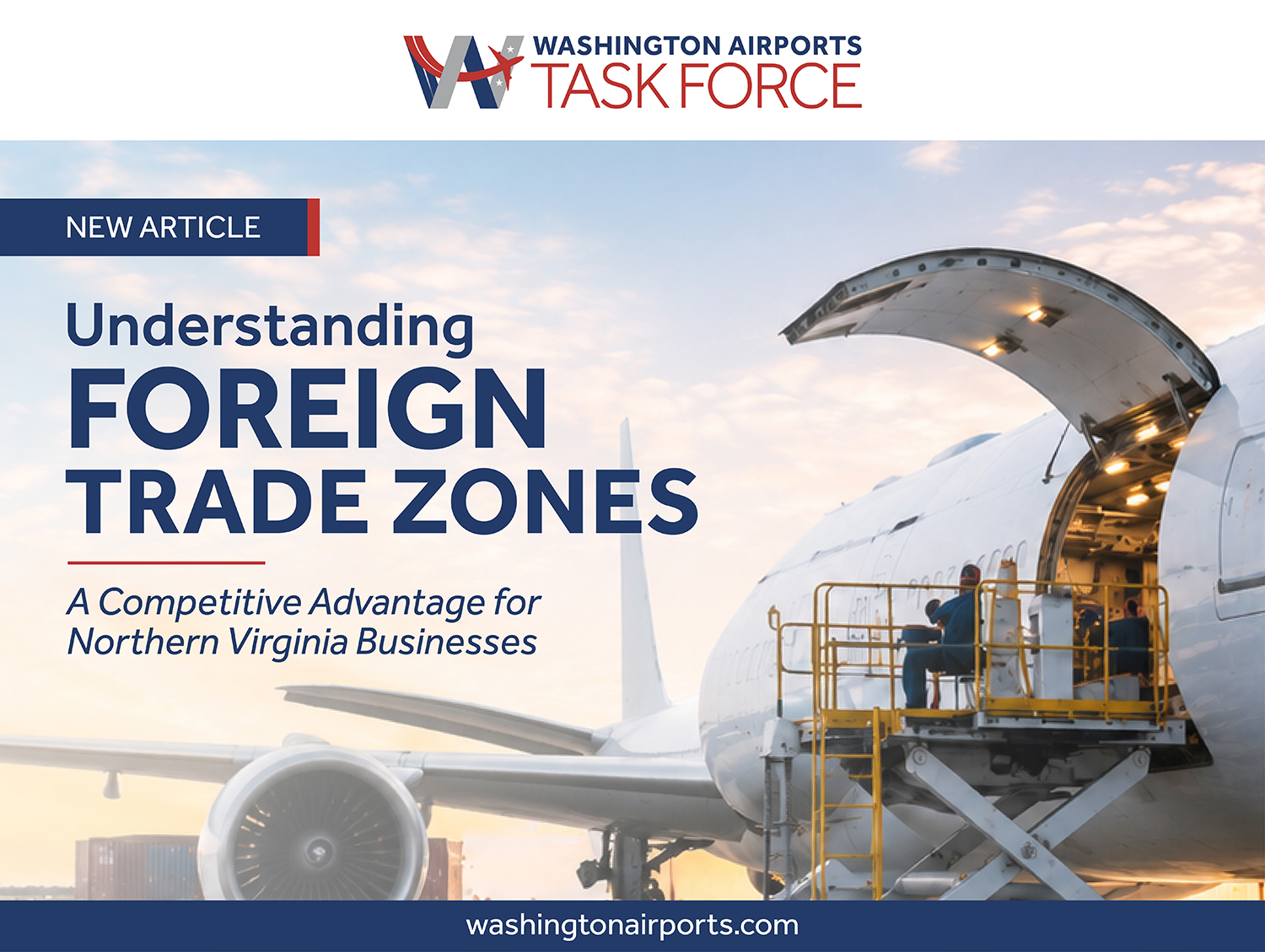
For Northern Virginia businesses engaged in international trade, there’s a powerful but underutilized tool that can provide significant competitive advantages: Foreign Trade Zones. If your company imports products, manufactures goods with foreign components, or exports to international markets, understanding Foreign Trade Zones (FTZs) could unlock substantial cost savings and operational efficiencies.
The Washington Airports Task Force administers Foreign Trade Zone #137, located at Washington Dulles International Airport, serving businesses across Frederick, Clarke, Loudoun, Fairfax, Fauquier, Prince William, and Arlington counties, plus the City of Alexandria. Here’s what every Northern Virginia business leader should know about this economic development tool.
What is a Foreign Trade Zone?
The Foreign Trade Zones program was established by the FTZ Act of 1934 during the Great Depression. The program’s original purpose—and its mission today—is to provide a competitive advantage for companies with locations on U.S. soil by offering savings on Customs duties.
In the 1930s, American companies faced a challenge: labor and operating costs were lower abroad, creating pressure to move operations offshore. The FTZ program addressed this by removing certain financial disincentives associated with manufacturing in the United States. By providing duty savings, the program encouraged companies to maintain and grow their businesses in America rather than relocating to foreign countries.
Nearly 90 years later, in an even more globalized economy, the FTZ program remains highly relevant. Approval for FTZ designation is given by the FTZ Board, an independent agency within the U.S. Department of Commerce.
How Foreign Trade Zones Work
The mechanics of FTZs center on three key benefits: duty deferral, duty reduction, and duty elimination.
Duty Deferral
When foreign merchandise enters a Foreign Trade Zone, Customs duties are not immediately due. Companies can store, manufacture, or process goods within the FTZ without paying duties until—and unless—the merchandise enters U.S. commerce.
This creates significant cash flow advantages. Instead of paying duties upon importation and tying up capital, businesses can defer payment until goods are actually sold into the U.S. market. For companies with high inventory turnover or extended manufacturing cycles, this deferral can translate into substantial working capital savings.
Duty on machinery and equipment is deferred until it’s put into production. There’s no duty paid on goods that are re-exported or on scrap and damaged merchandise.
Duty Reduction (Inverted Tariff Relief)
One of the most powerful FTZ benefits addresses a competitive imbalance in the tariff system. When a product is manufactured abroad and imported to the U.S., duty is paid at the rate of the finished product. However, when a U.S.-based manufacturer imports components to assemble a finished product, duties are typically paid on each component—which can result in higher overall duty costs than the finished product would carry.
This puts U.S. manufacturers at a disadvantage compared to foreign competitors. FTZs correct this imbalance.
Within an FTZ, companies can choose to pay duty either on the foreign components used in manufacturing or on the finished product—whichever rate is lower. This is called “inverted tariff” relief. When the duty rate on the finished product is lower than the combined rates on imported components, FTZ users pay the lower rate, leveling the playing field with offshore manufacturers.
Duty Elimination
If merchandise admitted to an FTZ is subsequently exported from the United States, no Customs duties are ever paid. This is particularly valuable for:
- Companies that import components, assemble products, and export finished goods
- Distribution centers serving international markets
- Businesses that import goods for processing before re-export
- Companies that discover defective or damaged merchandise and choose to return it to suppliers abroad
Additionally, goods that are broken, scrapped, or destroyed within the FTZ are not subject to duty, providing savings when inventory becomes obsolete or damaged.
Who Benefits from Foreign Trade Zones?
Any company that imports products into the United States and performs certain operations could qualify for the FTZ program. According to federal regulations, merchandise in a zone can be:
- Assembled
- Cleaned
- Displayed
- Destroyed
- Exhibited
- Manipulated
- Manufactured
- Mixed
- Processed
- Relabeled
- Repackaged
- Repaired
- Salvaged
- Sampled
- Stored
- Tested
Industries That Commonly Use FTZs
- Manufacturing: Companies that import components or raw materials for production benefit from inverted tariff relief and duty deferral on work-in-process inventory.
- Distribution and Warehousing: Importers who store goods before distribution can defer duties until products enter U.S. commerce, improving cash flow.
- Assembly Operations: Businesses that assemble finished products from foreign components can choose the most advantageous duty rate.
- Export-Oriented Businesses: Companies that import materials for products ultimately destined for export markets can avoid duties entirely.
- Technology and Electronics: Firms importing parts for assembly, testing, or repair operations benefit from multiple FTZ advantages.
- Pharmaceuticals and Medical Devices: Companies importing active ingredients or components for processing can leverage duty savings.
When FTZ Benefits Are Most Significant
Foreign Trade Zones provide the greatest advantages when:
- Your business involves testing, quality control, or inspection that may result in rejected or returned merchandise
- Your company imports high-value merchandise subject to substantial duty rates
- You maintain significant inventory that could benefit from duty deferral
- Your manufacturing process creates an inverted tariff situation
- You export a portion of imported goods
- You file multiple Customs entries weekly (FTZs allow consolidated weekly entries rather than per-shipment processing)
WATF’s Role: Administering FTZ #137
The Washington Airports Task Force serves as the grantee and administrator of Foreign Trade Zone #137, located at Washington Dulles International Airport. The FTZ operates under the Alternative Site Framework (ASF), which provides greater flexibility when adding new zone operations and expedited FTZ Board applications.
Service Area
FTZ #137’s service area includes:
- Frederick County
- Clarke County
- Loudoun County
- Fairfax County
- Fauquier County
- Prince William County
- Arlington County
- City of Alexandria
This broad geographic coverage means businesses throughout Northern Virginia can access FTZ benefits, not just companies located at Dulles Airport.
Alternative Site Framework Advantage
In 2014, the FTZ Board modernized the program by introducing the Alternative Site Framework. FTZ #137 operates under this framework, which allows:
- More efficient application processes for companies seeking FTZ designation
- Faster approval timelines (30 days for minor boundary modifications)
- Greater flexibility in designating new sites within the service area
- Streamlined procedures for adding new FTZ users
This modern framework makes accessing FTZ benefits more practical for mid-sized businesses that might have found the traditional process too cumbersome.
WATF’s Mission Connection
Administering FTZ #137 aligns directly with WATF’s core mission: promoting economic development and job creation in Northern Virginia. By providing businesses with tools to compete more effectively in global markets, the FTZ program helps:
- Leverage Dulles Airport’s international connectivity for economic advantage
- Attract and retain companies that serve international markets
- Support job creation in manufacturing, distribution, and logistics
- Strengthen Northern Virginia’s position as a global business hub
How to Get Started with FTZ #137
If your Northern Virginia business could benefit from Foreign Trade Zone designation, here’s the process:
Step 1: Assess Your Potential Benefits
Evaluate whether FTZ benefits align with your business operations:
- Calculate potential duty savings based on your import volume and tariff rates
- Consider cash flow improvements from duty deferral
- Assess administrative efficiencies from consolidated Customs processing
- Determine if inverted tariff relief applies to your manufacturing processes
Step 2: Contact WATF
Reach out to the Washington Airports Task Force to discuss your company’s specific situation and FTZ eligibility.
Contact Information:
- Washington Airports Task Force
- 45005 Aviation Drive, Suite 130
- Dulles, VA 20166
- Visit: www.washingtonairports.com/foreign-trade-zone
WATF staff can provide guidance on:
- Whether your operations qualify for FTZ benefits
- The application process and timeline
- Cost-benefit analysis specific to your business
- Site designation requirements
Step 3: Federal Application Process
Once you’ve determined FTZ benefits are appropriate for your company:
- Initial Consultation: Work with WATF as the zone grantee
- Site Designation Application: WATF obtains comments from local U.S. Customs and Border Protection office
- FTZ Board Submission: WATF submits your application to the Foreign Trade Zones Board
- Approval Timeline: Under the Alternative Site Framework, minor boundary modifications are typically approved within 30 days
Step 4: Activation and Operations
After approval:
- Implement FTZ procedures within your operations
- Train staff on FTZ documentation and compliance requirements
- Begin realizing duty savings, cash flow improvements, and operational efficiencies
- Maintain compliance with FTZ regulations and Customs requirements
The Competitive Advantage
In today’s global economy, competitive advantages matter. Foreign Trade Zones provide tangible financial benefits that can improve a company’s bottom line while supporting American jobs and operations.
For Northern Virginia businesses, FTZ #137 offers proximity to Washington Dulles International Airport—one of the nation’s top 10 gateways—combined with access to international supply chains and markets. This combination of location and program benefits creates unique opportunities for companies serving global customers.
The FTZ program isn’t just about saving money on duties, though those savings can be substantial. It’s about creating a more level playing field for U.S.-based operations competing against foreign manufacturers, removing disincentives that might otherwise push companies to locate production offshore, and supporting regional economic development through smart policy tools.
Looking Forward
As Northern Virginia continues to attract technology companies, advanced manufacturers, and globally-oriented businesses, Foreign Trade Zone #137 will remain a valuable economic development asset. The program’s flexibility under the Alternative Site Framework makes it increasingly accessible to mid-sized companies, not just large multinational corporations.
The Washington Airports Task Force’s administration of FTZ #137 reflects the organization’s broader mission: leveraging aviation infrastructure and related programs to drive regional economic prosperity. Just as improved air service at Dulles and Reagan National airports creates connectivity and opportunity, the Foreign Trade Zone program creates financial advantages that help businesses compete and grow.
If your Northern Virginia business imports goods, manufactures products with foreign components, or serves international markets, exploring Foreign Trade Zone benefits could be one of the smartest strategic moves you make this year.
About WATF
The Washington Airports Task Force is a nonprofit, non-partisan 501(c)(3) organization that advocates for expanding and enhancing aviation services in Virginia and the National Capital Region. Since 1982, WATF has worked to promote job creation and economic growth through improved air service at Washington Dulles International Airport and Ronald Reagan Washington National Airport. To learn more, visit www.washingtonairports.com.