
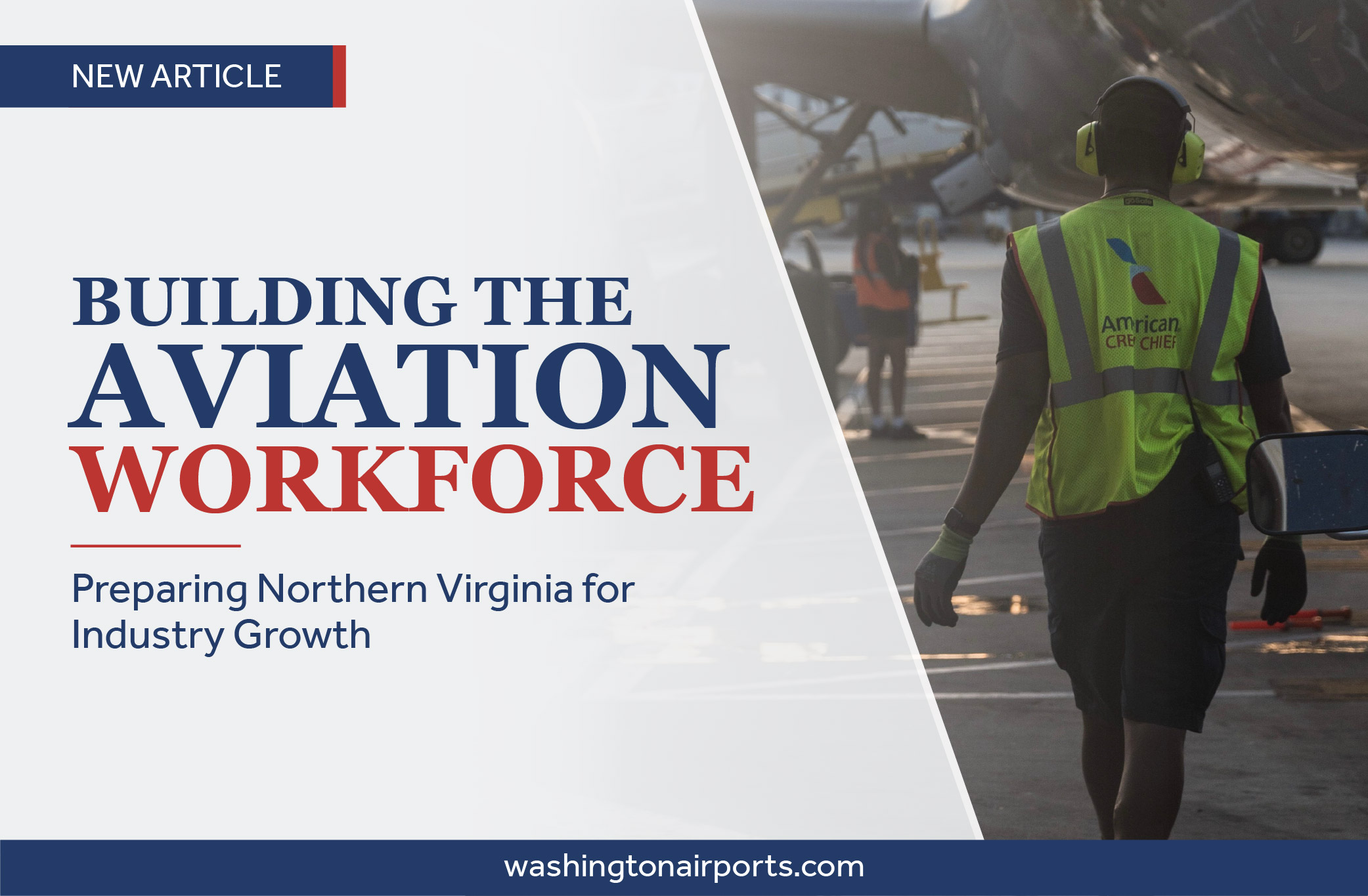
The aviation industry is thriving, but it faces a critical challenge: finding and developing the skilled professionals needed to keep planes flying, airports operating, and passengers safe. For Northern Virginia and the Nation’s Capital, this challenge represents both an urgent need and a significant opportunity.
As Washington Dulles International Airport and Ronald Reagan Washington National Airport continue to grow, the demand for aviation professionals grows alongside them. From pilots and aircraft maintenance technicians to air traffic controllers and airport operations managers, our region needs a robust pipeline of talented people entering aviation careers. The good news? Our region is uniquely positioned to meet this challenge.
The Aviation Workforce Challenge
The aviation industry is experiencing workforce shortages not seen in decades. According to industry projections, the U.S. will need thousands of new commercial pilots, mechanics, air traffic controllers, and aviation support professionals over the next decade.
The causes are varied. Many experienced aviation professionals are reaching retirement age. Career paths that once seemed clearly defined have become less certain due to industry disruptions. Training costs, particularly for pilot certification, have become prohibitively expensive for many candidates. And younger generations may not realize the opportunities available in aviation careers.

For Northern Virginia specifically, these national trends have local consequences. Our two major airports—Dulles and Reagan National—employ thousands of people across multiple aviation sectors. When the national pilot shortage affects airlines, it affects Northern Virginia-based carriers and their operations. When aircraft maintenance facilities struggle to find qualified technicians, it impacts our region’s aviation ecosystem.
But here’s the opportunity: Northern Virginia has assets that can help solve this problem, and organizations like Washington Airports Task Force (WATF) recognize that workforce development is essential to long-term aviation growth.
Career Pathways in Aviation
When most people think of aviation careers, they imagine pilots. While pilots are certainly part of the story, aviation offers far more diverse career paths than many realize.
Pilots and Flight Crew
Commercial airline pilots, cargo pilots, corporate jet pilots, and flight instructors represent the most visible aviation careers. Becoming a commercial pilot requires significant training and certification, but the career offers competitive salaries and global opportunities.
Aircraft Maintenance Technicians
Aircraft maintenance is a hands-on, skilled trade. Mechanics and technicians inspect, repair, and maintain aircraft systems. These professionals earn strong salaries and enjoy job security—planes can’t fly without properly maintained systems.
Air Traffic Controllers
The Federal Aviation Administration operates the nation’s air traffic control system. Controllers manage aircraft movement on the ground and in the air. This demanding career requires specialized training but offers excellent compensation and benefits.
Airport Operations and Management
Airports require professionals in ground operations, customer service, security, logistics, and management. These roles offer diverse career paths within a single facility.
Aviation Support Roles
Avionics technicians, flight dispatchers, fuel specialists, ramp agents, and customer service professionals all play essential roles in aviation operations.
Northern Virginia’s Educational Assets
Northern Virginia is home to world-class educational institutions that are stepping up to support aviation workforce development.
Universities
George Mason University, Virginia Tech, Liberty University, and other regional universities offer aerospace engineering, aviation management, and related degree programs. These institutions provide pathways for students seeking bachelor’s and advanced degrees in aviation-related fields.
Community Colleges
Northern Virginia Community College (NOVA) and other community college systems offer aircraft maintenance technology programs, aviation operations certificates, and specialized training. Community colleges provide affordable, accessible education that prepares students for direct entry into aviation careers.
Flight Training Centers
Private flight training organizations throughout the region provide pilot certification courses, maintenance training, and specialized aviation education. These facilities serve career-changers, military veterans transitioning to civilian aviation, and students pursuing aviation as a primary career path.
High School Programs
Some Northern Virginia high schools offer aviation-focused curricula and partnerships with local aviation employers. These early-exposure programs help students discover aviation career interests while still in secondary education.
This educational infrastructure already exists. The challenge now is awareness, accessibility, and alignment between what educators teach and what employers need.
Employment Opportunities at Dulles and Reagan National
Washington Dulles International Airport and Ronald Reagan Washington National Airport represent significant employment hubs in aviation.
As a major international gateway with global airline operations, Dulles requires pilots experienced in international routes, mechanics certified for wide-body aircraft, and operational staff managing complex global flight schedules.
The nation’s slot-controlled airport serving the National Capital Region demands air traffic controllers, customer service professionals, ground operations staff, and security specialists managing one of the country’s busiest domestic airports.
Both airports employ thousands directly and support thousands more through airline operations, ground handling services, retail, security, and support functions. These aren’t just jobs—they’re careers with advancement potential, competitive compensation, and the satisfaction of contributing to critical infrastructure.
Industry Partnerships
Workforce development requires collaboration between educators, employers, and organizations like WATF.
Employer-Educator Partnerships
When airlines, airport operators, and training facilities work closely with educational institutions, curriculum stays aligned with industry needs. Students learn skills employers actually require.

Apprenticeship Programs
Earn-while-you-learn programs allow students to gain employment experience and income while completing training. This approach has proven effective in developing skilled technicians and operations professionals.
Military Transition Support
Northern Virginia’s military population includes thousands of veterans with aviation experience. Establishing clear pathways for military aviators and technicians to transition to civilian aviation careers leverages existing talent and experience.
Industry Outreach
High school career fairs, community college partnerships, and public awareness campaigns help students discover aviation careers earlier in their educational journey.
WATF’s Perspective on Workforce Development
The Washington Airports Task Force recognizes that workforce development is central to regional aviation growth. Strong aviation infrastructure requires people who understand it, maintain it, and improve it.
The Committee for Dulles Community Outreach (CFDCO) supports this mission through scholarship programs. Since 2012, CFDCO has awarded 340 scholarships totaling $517,000 to high school graduating seniors pursuing careers in aviation, aerospace, and related fields. These scholarships remove financial barriers and demonstrate industry commitment to developing the next generation.
But more is needed. Sustained partnerships between aviation employers, educational institutions, workforce development agencies, and regional organizations like WATF can address workforce challenges strategically.
Opportunities for Students and Career Changers
Whether you’re a high school student exploring career options or an adult considering a career change, aviation offers genuine opportunities in Northern Virginia.
For Students: Start early. Take aviation-focused high school courses, visit Dulles or Reagan National to understand operations, connect with community college aviation programs, and explore educational pathways in your area.
For Career Changers: The military-to-civilian transition, professional retraining programs, and community college certificates provide pathways into aviation without requiring four-year degrees. Your previous career experience and maturity often make you an attractive candidate for aviation employers.
For Employers: Investing in employee development, partnering with educational institutions, and creating clear career pathways helps you attract and retain talented staff in an increasingly competitive labor market.
Building Northern Virginia’s Aviation Future
The aviation workforce challenge is real, but it’s solvable. Northern Virginia has the educational infrastructure, the employment opportunities, the regional commitment, and the transportation assets to become a leader in aviation workforce development.
This requires sustained effort from multiple stakeholders—educators developing curriculum, employers offering opportunities, institutions like WATF supporting scholarships and partnerships, and young people and career-changers choosing aviation careers.
The result? A robust pipeline of skilled professionals keeping our region’s world-class airports operating safely and efficiently. A competitive advantage for Northern Virginia businesses relying on aviation connectivity. And meaningful, well-compensated careers for thousands of our region’s residents.
The aviation workforce opportunity is here. The question is: are you ready to soar?
About WATF
The Washington Airports Task Force is a nonprofit, non-partisan 501(c)(3) organization that advocates for expanding and enhancing aviation services in Virginia and the National Capital Region. Since 1982, WATF has worked to promote job creation and economic growth through improved air service at Washington Dulles International Airport and Ronald Reagan Washington National Airport. To learn more, visit www.washingtonairports.com.