Washington Airports Task Force Celebrates 30 Years of the Williams Trophy, Announces United Airlines and MWAA as 2026 Recipients

Annual General Meeting will also debut the Leo Schefer Community Impact Award and feature a special fundraiser benefiting Special Olympics Virginia

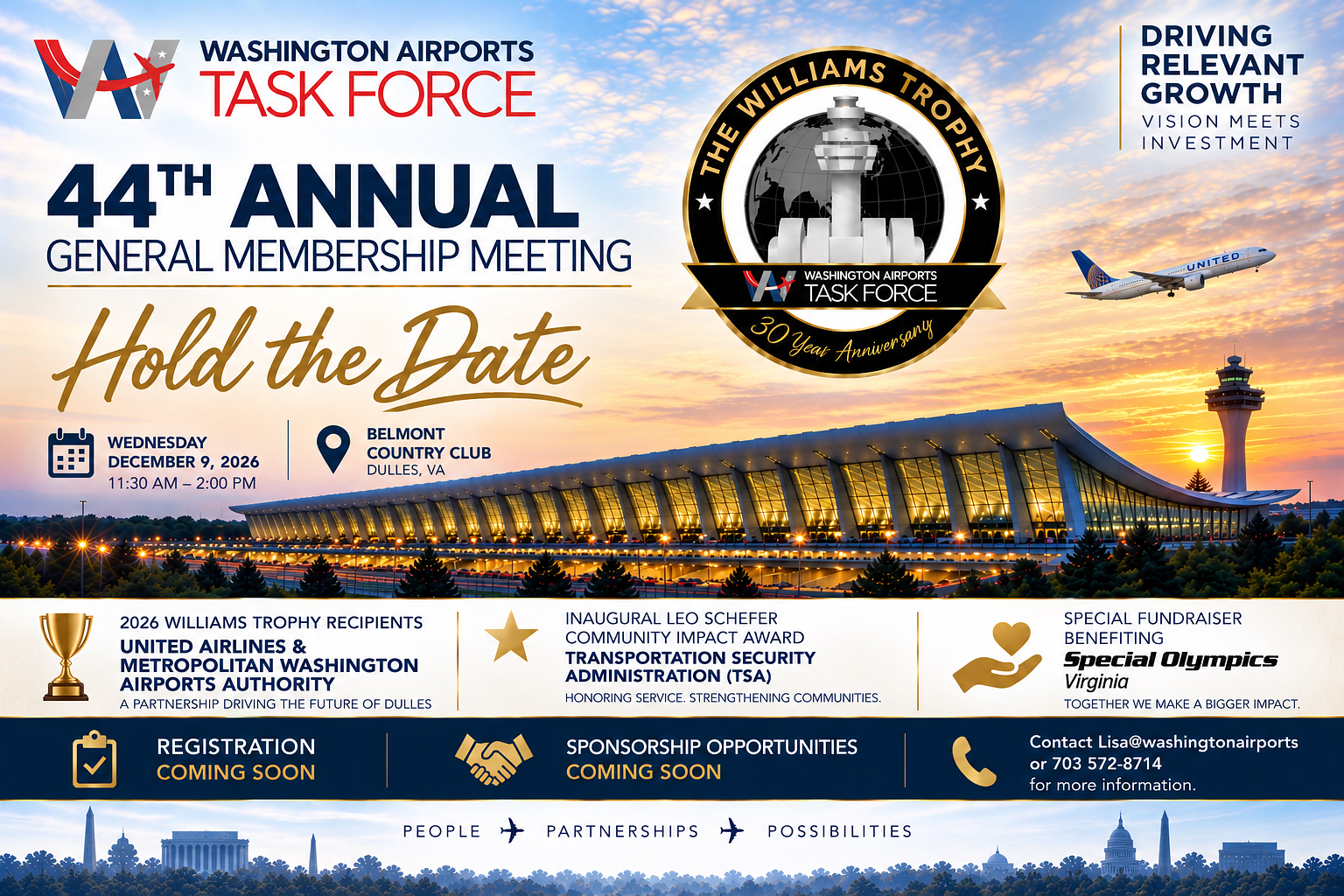
DULLES, Va. — August 2026 — The Washington Airports Task Force will celebrate the 30th Anniversary of the Williams Trophy at its 44th Annual General Membership Meeting on December 9, 2026, at Belmont Country Club, recognizing three decades of leadership, vision, innovation, and partnership that have helped advance aviation and its impact on the National Capital Region.

Highlighting this milestone year, WATF is proud to announce United Airlines and the Metropolitan Washington Airports Authority (MWAA) as the 2026 Williams Trophy recipients, recognizing their longstanding partnership, continued investment, and shared commitment to the future of Washington Dulles International Airport.

Established in 1996 by the WATF Board of Directors, the Williams Trophy honors the legacy of Carrington Williams, WATF’s founding chairman and the Trophy’s first recipient. For three decades, the award has recognized individuals and organizations whose “Leadership, Vision and Dedication in the Application of Aviation or Space Enrich the Quality of Life on Earth.”

“Celebrating 30 years of the Williams Trophy gives us an opportunity to recognize not only this year’s recipients, but the incredible legacy of leadership and vision this award represents,” said Keith Meurlin, President, Washington Airports Task Force. “United and MWAA are carrying that legacy forward through their continued partnership and investment at Dulles—demonstrating exactly what our 2026 theme, Driving Relevant Growth — Vision Meets Investment, is all about.”

A Partnership Driving the Future of Dulles

United Airlines and MWAA’s continued investment at Washington Dulles is expanding global connectivity, strengthening the airport’s role as an international gateway, enhancing the passenger experience, and supporting economic growth throughout the National Capital Region.

Their selection reflects WATF’s 2026 priorities to advance infrastructure and airline growth at Dulles, strengthen aviation’s regional economic impact, and build the partnerships necessary to keep the region’s airport system competitive.

The recognition comes at a pivotal time for Dulles as significant public- and private-sector investment sets the stage for the airport’s next era of growth.

Introducing the Leo Schefer Community Impact Award

WATF will also use this year’s AGM to introduce the Leo Schefer Community Impact Award, a new honor recognizing the legacy of former WATF President Leo Schefer and his decades of leadership, public service, and commitment to aviation, regional connectivity, and economic growth. The award honors individuals and/or organizations whose leadership, service, and collaboration create a meaningful and lasting impact on our airports and the communities they serve.

The Transportation Security Administration (TSA) team at Washington Dulles International Airport has been selected as the award’s inaugural recipient.

The team is being recognized for its exceptional leadership, professionalism, and dedication during the recent government shutdown, maintaining safe and efficient checkpoint operations, supporting its workforce, and helping minimize impacts to the traveling public.

Celebrating Aviation While Giving Back

Adding another special element to this year’s program, WATF will host a special fundraising event benefiting Special Olympics Virginia.

Community partnership has long been part of the Dulles aviation community, and the fundraiser will provide WATF members, partners, and guests an opportunity to come together in support of an organization with a longstanding connection to the airport community.

Together, the Williams Trophy’s 30th Anniversary, the introduction of the Leo Schefer Community Impact Award, and the Special Olympics Virginia fundraiser reflect the continued evolution of WATF’s Annual General Meeting. The event brings together leaders and professionals from aviation, business, government, economic development, and the broader regional community to strengthen relationships, recognize achievement, and help shape what comes next for aviation.

It all ties back to Driving Relevant Growth—where vision meets investment and partnerships, leadership, and community come together to move our region forward.

2026 WATF Annual General Membership Meeting & Williams Trophy Presentation

Wednesday, December 9, 2026
Belmont Country Club

Formal invitations and registration information, along with additional details regarding the program, special guests, fundraising event, and sponsorship opportunities, will be announced in the coming weeks.

About the Washington Airports Task Force

Founded in 1982, the Washington Airports Task Force (WATF) is a non-partisan, non-profit organization dedicated to promoting and expanding aviation services for Virginia and the National Capital Region. Through advocacy, collaboration, education, and industry engagement, WATF works with public- and private-sector partners to strengthen the region’s airport system, enhance connectivity, and support continued economic growth.

Media Contact:
Lisa Merhaut
Washington Airports Task Force
703-572-8714
[email protected]
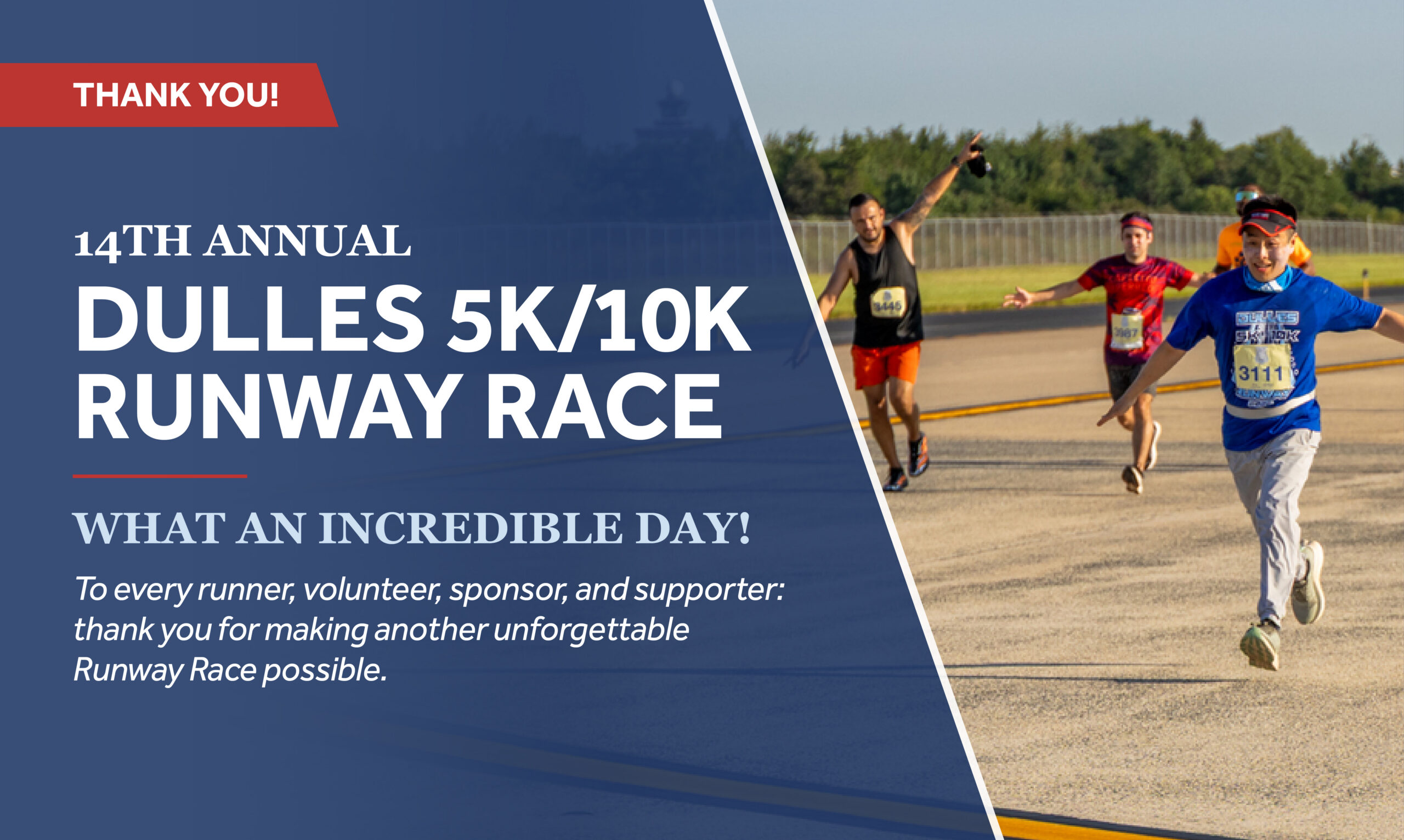
What an Incredible Turnout for the 14th Annual Dulles 5K/10K on the Runway!

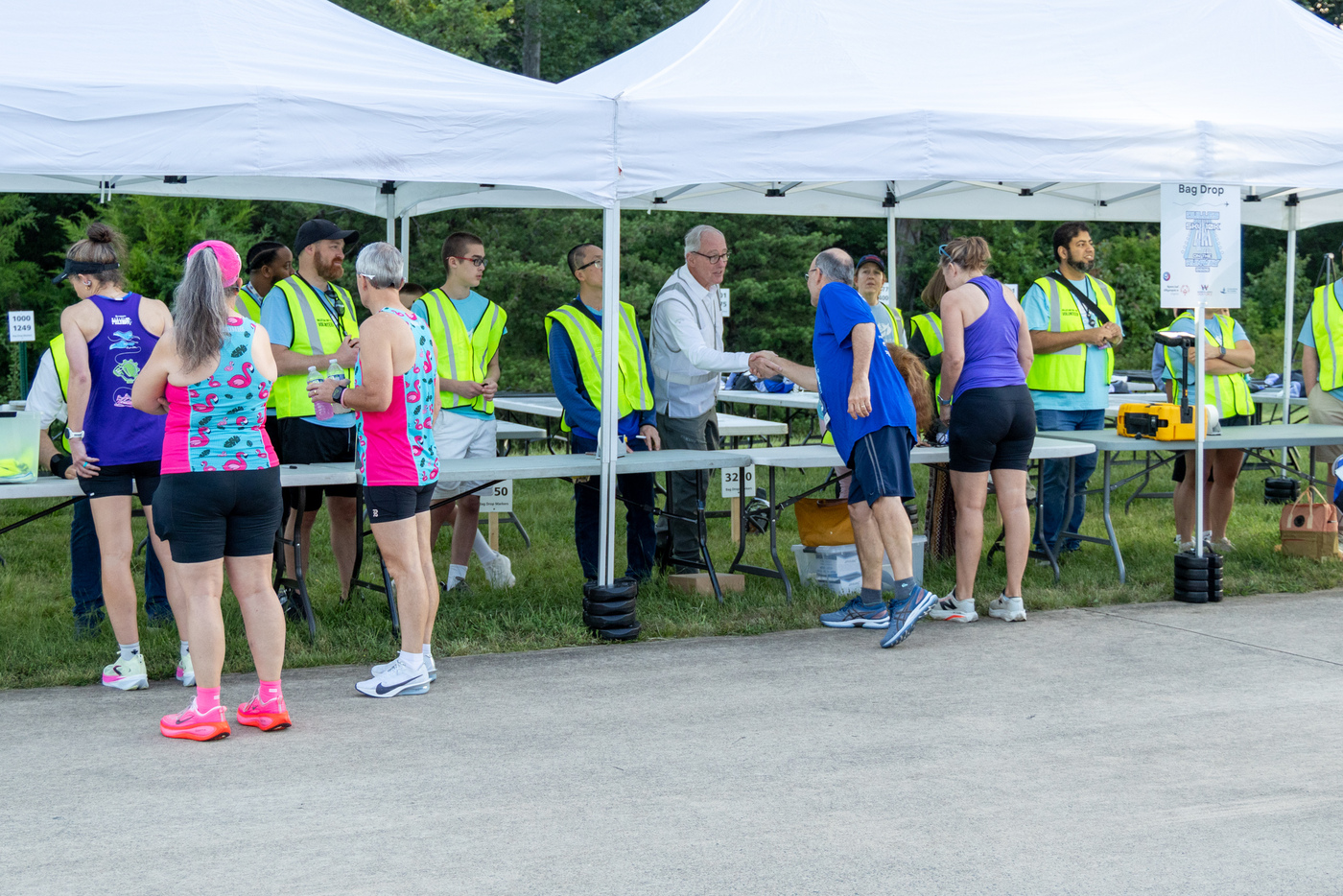
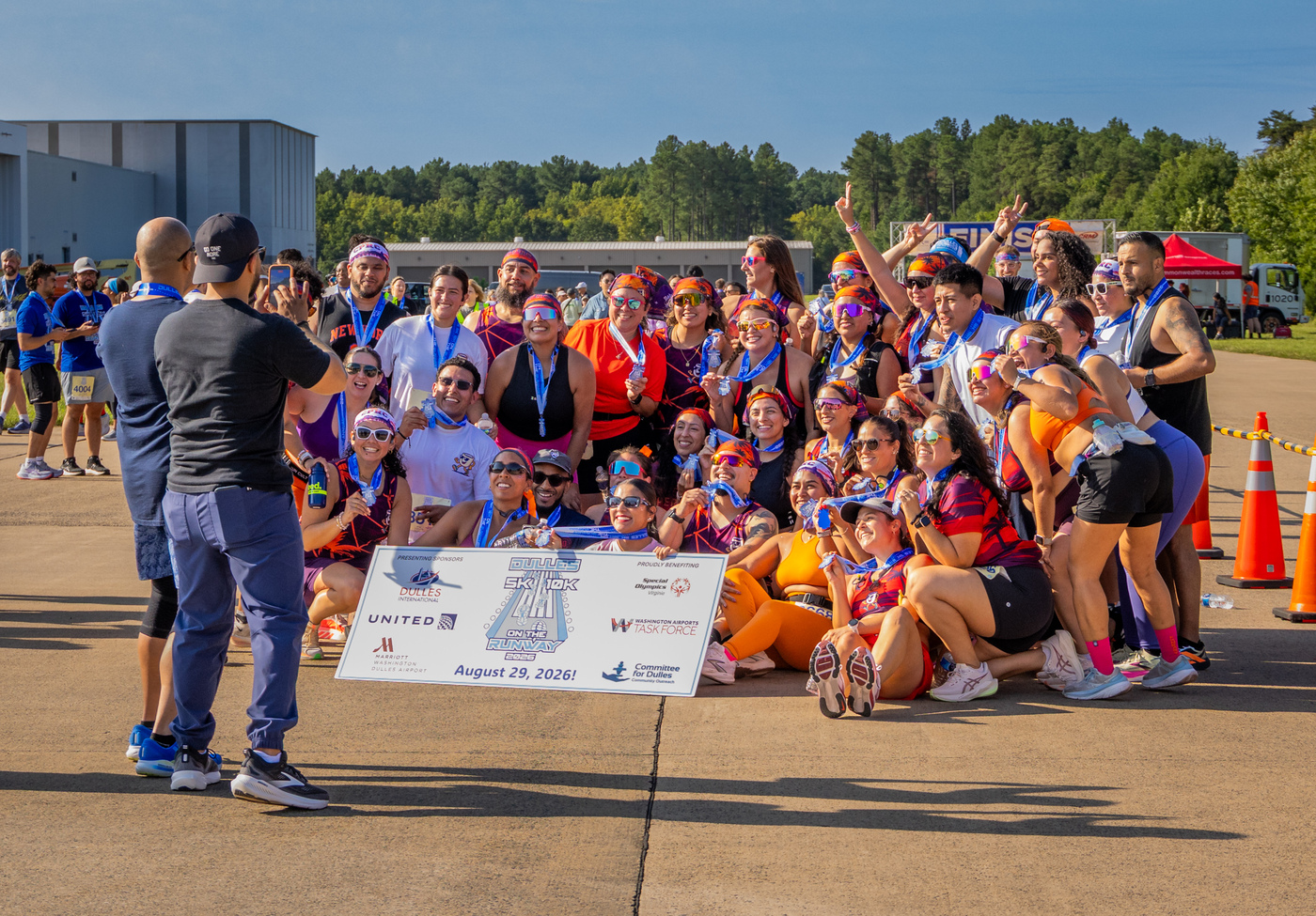
Approximately 2,789 runners registered, with an impressive 91% participating in this year’s race at Washington Dulles International Airport. Combined with spectators, 3,046 people came through the Steven F. Udvar-Hazy Center as part of this unforgettable event.

And they came from near and far—with participants traveling from California, Texas, Ohio, Pennsylvania, and even Germany to experience the rare opportunity to run on an actual runway at Dulles!

This unique event showcases what’s possible when organizations like WATF and our presenting sponsors, to include Dulles International Airport, United Airlines, and Marriott Washington Dulles Airport, partner around shared community values.

Race proceeds benefit Special Olympics Virginia, the Committee for Dulles Community Outreach, and the Washington Airports Task Force, all 501c3 nonprofit organizations closely affiliated with Dulles Airport.

To every participant, volunteer, sponsor (see the full list of sponsors), and supporter: thank you! Your participation fuels WATF’s advocacy for aviation expansion and economic development in our region.

To view race results, visit click here.
To view some photos, click here.

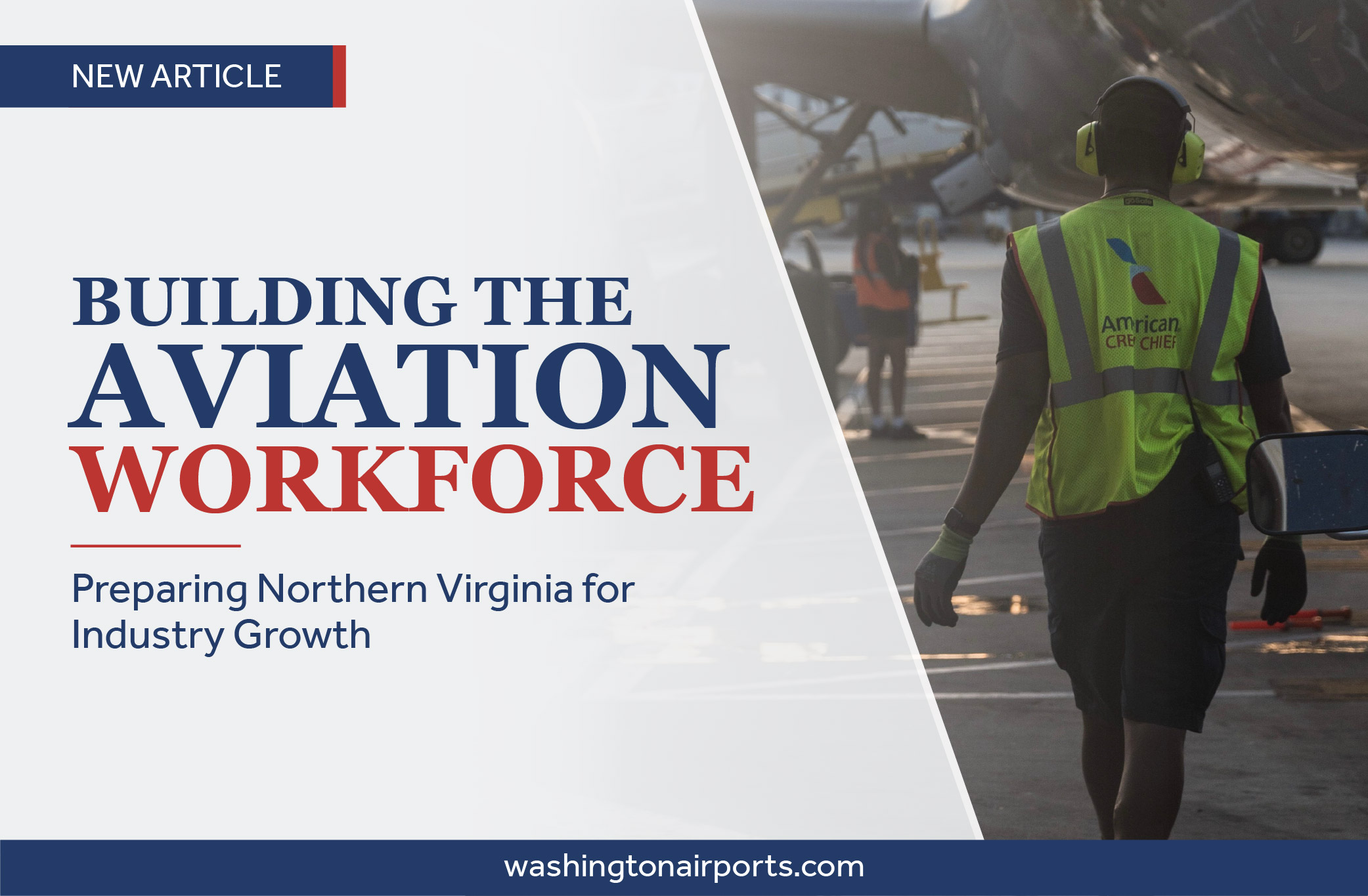
Building the Aviation Workforce: Preparing Northern Virginia for Industry Growth

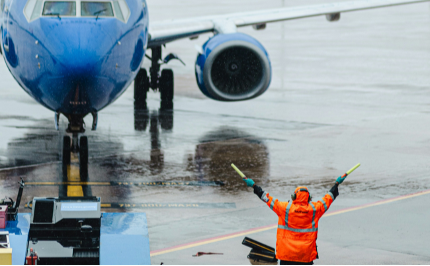
The aviation industry is thriving, but it faces a critical challenge: finding and developing the skilled professionals needed to keep planes flying, airports operating, and passengers safe. For Northern Virginia and the Nation’s Capital, this challenge represents both an urgent need and a significant opportunity.

As Washington Dulles International Airport and Ronald Reagan Washington National Airport continue to grow, the demand for aviation professionals grows alongside them. From pilots and aircraft maintenance technicians to air traffic controllers and airport operations managers, our region needs a robust pipeline of talented people entering aviation careers. The good news? Our region is uniquely positioned to meet this challenge.

The Aviation Workforce Challenge

The aviation industry is experiencing workforce shortages not seen in decades. According to industry projections, the U.S. will need thousands of new commercial pilots, mechanics, air traffic controllers, and aviation support professionals over the next decade.

The causes are varied. Many experienced aviation professionals are reaching retirement age. Career paths that once seemed clearly defined have become less certain due to industry disruptions. Training costs, particularly for pilot certification, have become prohibitively expensive for many candidates. And younger generations may not realize the opportunities available in aviation careers.

For Northern Virginia specifically, these national trends have local consequences. Our two major airports—Dulles and Reagan National—employ thousands of people across multiple aviation sectors. When the national pilot shortage affects airlines, it affects Northern Virginia-based carriers and their operations. When aircraft maintenance facilities struggle to find qualified technicians, it impacts our region’s aviation ecosystem.

But here’s the opportunity: Northern Virginia has assets that can help solve this problem, and organizations like Washington Airports Task Force (WATF) recognize that workforce development is essential to long-term aviation growth.

Career Pathways in Aviation

When most people think of aviation careers, they imagine pilots. While pilots are certainly part of the story, aviation offers far more diverse career paths than many realize.

Pilots and Flight Crew

Commercial airline pilots, cargo pilots, corporate jet pilots, and flight instructors represent the most visible aviation careers. Becoming a commercial pilot requires significant training and certification, but the career offers competitive salaries and global opportunities.

Aircraft Maintenance Technicians

Aircraft maintenance is a hands-on, skilled trade. Mechanics and technicians inspect, repair, and maintain aircraft systems. These professionals earn strong salaries and enjoy job security—planes can’t fly without properly maintained systems.

Air Traffic Controllers

The Federal Aviation Administration operates the nation’s air traffic control system. Controllers manage aircraft movement on the ground and in the air. This demanding career requires specialized training but offers excellent compensation and benefits.

Airport Operations and Management

Airports require professionals in ground operations, customer service, security, logistics, and management. These roles offer diverse career paths within a single facility.

Aviation Support Roles

Avionics technicians, flight dispatchers, fuel specialists, ramp agents, and customer service professionals all play essential roles in aviation operations.

Northern Virginia’s Educational Assets

Northern Virginia is home to world-class educational institutions that are stepping up to support aviation workforce development.

Universities

George Mason University, Virginia Tech, Liberty University, and other regional universities offer aerospace engineering, aviation management, and related degree programs. These institutions provide pathways for students seeking bachelor’s and advanced degrees in aviation-related fields.

Community Colleges

Northern Virginia Community College (NOVA) and other community college systems offer aircraft maintenance technology programs, aviation operations certificates, and specialized training. Community colleges provide affordable, accessible education that prepares students for direct entry into aviation careers.

Flight Training Centers

Private flight training organizations throughout the region provide pilot certification courses, maintenance training, and specialized aviation education. These facilities serve career-changers, military veterans transitioning to civilian aviation, and students pursuing aviation as a primary career path.

High School Programs

Some Northern Virginia high schools offer aviation-focused curricula and partnerships with local aviation employers. These early-exposure programs help students discover aviation career interests while still in secondary education.

This educational infrastructure already exists. The challenge now is awareness, accessibility, and alignment between what educators teach and what employers need.

Employment Opportunities at Dulles and Reagan National

Washington Dulles International Airport and Ronald Reagan Washington National Airport represent significant employment hubs in aviation.

As a major international gateway with global airline operations, Dulles requires pilots experienced in international routes, mechanics certified for wide-body aircraft, and operational staff managing complex global flight schedules.

The nation’s slot-controlled airport serving the National Capital Region demands air traffic controllers, customer service professionals, ground operations staff, and security specialists managing one of the country’s busiest domestic airports.

Both airports employ thousands directly and support thousands more through airline operations, ground handling services, retail, security, and support functions. These aren’t just jobs—they’re careers with advancement potential, competitive compensation, and the satisfaction of contributing to critical infrastructure.

Industry Partnerships

Workforce development requires collaboration between educators, employers, and organizations like WATF.

Employer-Educator Partnerships

When airlines, airport operators, and training facilities work closely with educational institutions, curriculum stays aligned with industry needs. Students learn skills employers actually require.

Apprenticeship Programs

Earn-while-you-learn programs allow students to gain employment experience and income while completing training. This approach has proven effective in developing skilled technicians and operations professionals.

Military Transition Support

Northern Virginia’s military population includes thousands of veterans with aviation experience. Establishing clear pathways for military aviators and technicians to transition to civilian aviation careers leverages existing talent and experience.

Industry Outreach

High school career fairs, community college partnerships, and public awareness campaigns help students discover aviation careers earlier in their educational journey.

WATF’s Perspective on Workforce Development

The Washington Airports Task Force recognizes that workforce development is central to regional aviation growth. Strong aviation infrastructure requires people who understand it, maintain it, and improve it.

The Committee for Dulles Community Outreach (CFDCO) supports this mission through scholarship programs. Since 2012, CFDCO has awarded 340 scholarships totaling $517,000 to high school graduating seniors pursuing careers in aviation, aerospace, and related fields. These scholarships remove financial barriers and demonstrate industry commitment to developing the next generation.

But more is needed. Sustained partnerships between aviation employers, educational institutions, workforce development agencies, and regional organizations like WATF can address workforce challenges strategically.

Opportunities for Students and Career Changers

Whether you’re a high school student exploring career options or an adult considering a career change, aviation offers genuine opportunities in Northern Virginia.

For Students: Start early. Take aviation-focused high school courses, visit Dulles or Reagan National to understand operations, connect with community college aviation programs, and explore educational pathways in your area.

For Career Changers: The military-to-civilian transition, professional retraining programs, and community college certificates provide pathways into aviation without requiring four-year degrees. Your previous career experience and maturity often make you an attractive candidate for aviation employers.

For Employers: Investing in employee development, partnering with educational institutions, and creating clear career pathways helps you attract and retain talented staff in an increasingly competitive labor market.

Building Northern Virginia’s Aviation Future

The aviation workforce challenge is real, but it’s solvable. Northern Virginia has the educational infrastructure, the employment opportunities, the regional commitment, and the transportation assets to become a leader in aviation workforce development.

This requires sustained effort from multiple stakeholders—educators developing curriculum, employers offering opportunities, institutions like WATF supporting scholarships and partnerships, and young people and career-changers choosing aviation careers.

The result? A robust pipeline of skilled professionals keeping our region’s world-class airports operating safely and efficiently. A competitive advantage for Northern Virginia businesses relying on aviation connectivity. And meaningful, well-compensated careers for thousands of our region’s residents.

The aviation workforce opportunity is here. The question is: are you ready to soar?


About WATF

The Washington Airports Task Force is a nonprofit, non-partisan 501(c)(3) organization that advocates for expanding and enhancing aviation services in Virginia and the National Capital Region. Since 1982, WATF has worked to promote job creation and economic growth through improved air service at Washington Dulles International Airport and Ronald Reagan Washington National Airport. To learn more, visit www.washingtonairports.com.

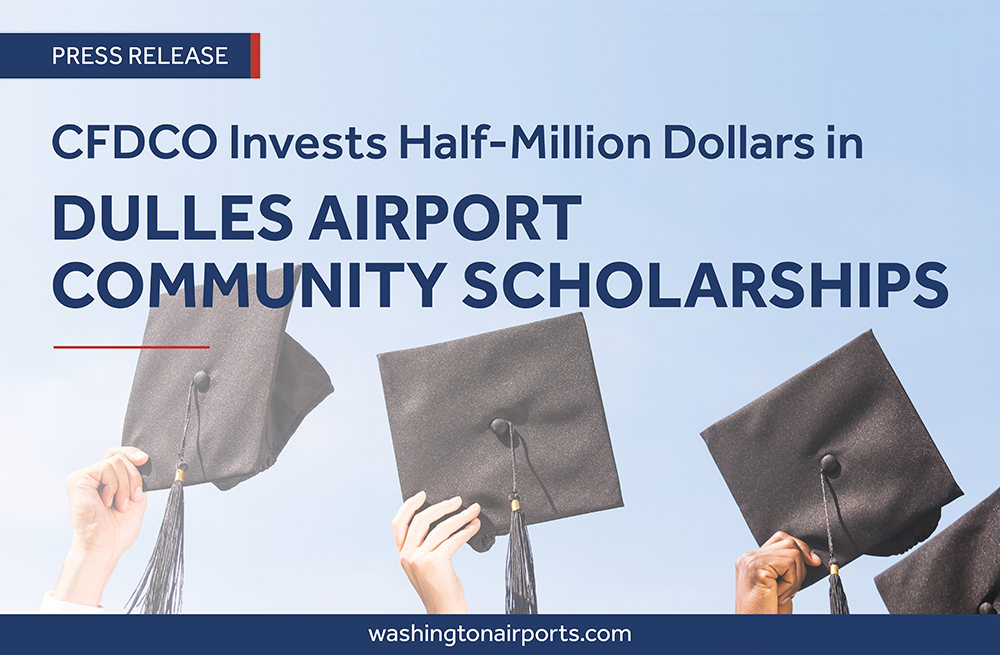
CFDCO Invests Half-Million Dollars in Dulles Airport Community Scholarships


The Committee for Dulles Community Outreach (CFDCO) is proud to announce a significant milestone for the Dulles Airport Scholarship Program. Since 2012, the CFDCO has awarded 340 scholarships totaling more than $517,000 and has provided $65,000 in grants to organizations serving the Dulles Airport community, including Travelers Aid and the Interfaith Chapel.

The CFDCO invests 100% of the proceeds it raises into scholarships and community grants. The volunteer-led 501(c)(3) organization funds the program through events such as the Dulles 5K/10K on the Runway, the Committee for Dulles Annual Golf Tournament, silent auctions, raffles, grants, and generous support from individuals and corporate partners.

This year, 27 graduating high school seniors were recipients of the Dulles Airport Scholarship and provided more than $42,000 to help students pursue higher education and skilled trades. The program supports students who work, volunteer, or have a parent or guardian who works or volunteers within the Dulles Airport community. Click here to view the 2026 scholarship recipients.

“Every scholarship application tells a story of determination, resilience, and a commitment to making a difference,” said Lisa Merhaut, President of the Committee for Dulles Community Outreach. “These students embody the values that make the Dulles Airport community so special, and we’re proud to invest in their future. We’re equally grateful to everyone whose generosity makes these scholarships possible.”

About the Committee for Dulles Community Outreach (CFDCO)
Established in 2012, CFDCO is the charitable arm of the Committee for Dulles and the Washington Airports Task Force. The organization is dedicated to supporting the Dulles Airport community by funding scholarships for graduating high school seniors and grants for organizations that serve airport employees, travelers, and the surrounding community.

For more information and how you can donate, please visit Committee for Dulles Community Outreach.

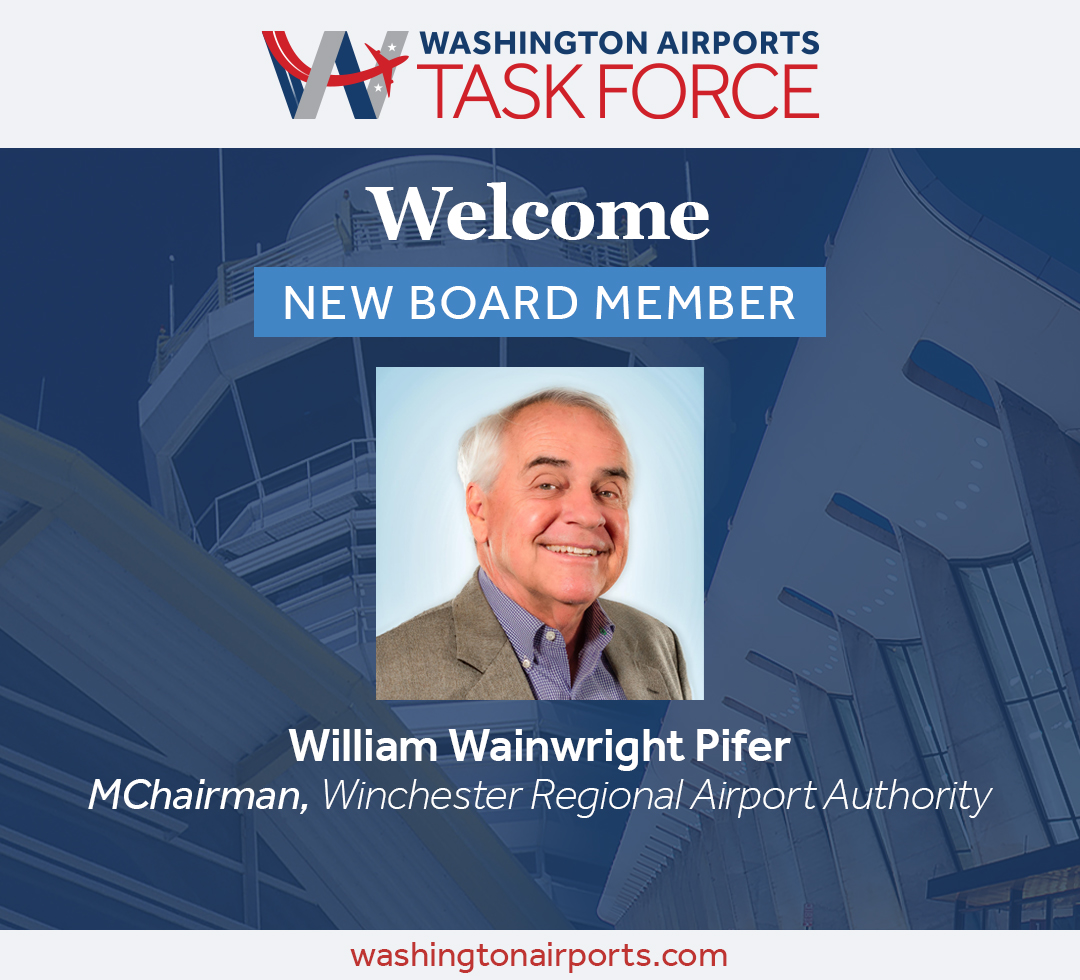
New Board Member: Washington Airports Task Force Welcomes William Wainwright Pifer to Board of Directors

The Washington Airports Task Force (WATF) is pleased to welcome William Pifer to its Board of Directors.

Bill brings decades of leadership in public service, business, and regional governance. He currently serves as Chairman of the Winchester Regional Airport Authority, representing the City of Winchester and the surrounding jurisdictions, and has held numerous leadership appointments throughout the Shenandoah Valley, including chairing several civic and nonprofit organizations.

His professional background includes service as a Congressional Chief of Staff, campaign management at both the state and federal levels, and extensive experience as a real estate investor in Virginia and North Carolina.

“Bill’s experience in aviation, regional leadership, and public service will be a tremendous asset to the Task Force as we continue advancing our mission of strengthening aviation and economic growth throughout the National Capital Region and the Commonwealth of Virginia,” said WATF President Keith Meurlin.

Please join us in welcoming Bill to the Washington Airports Task Force Board of Directors. We look forward to the leadership and perspective he will bring as we continue Driving Relevant Growth. The Washington Airports Task Force (WATF) is a Virginia 501(C)(3) non-profit corporation headed by regional and corporate leaders dedicated to expanding and enhancing aviation services in Virginia and the National Capital Region in order to stimulate job creation and economic expansion. The Task Force is involved in most major air and surface transportation initiatives in the region.

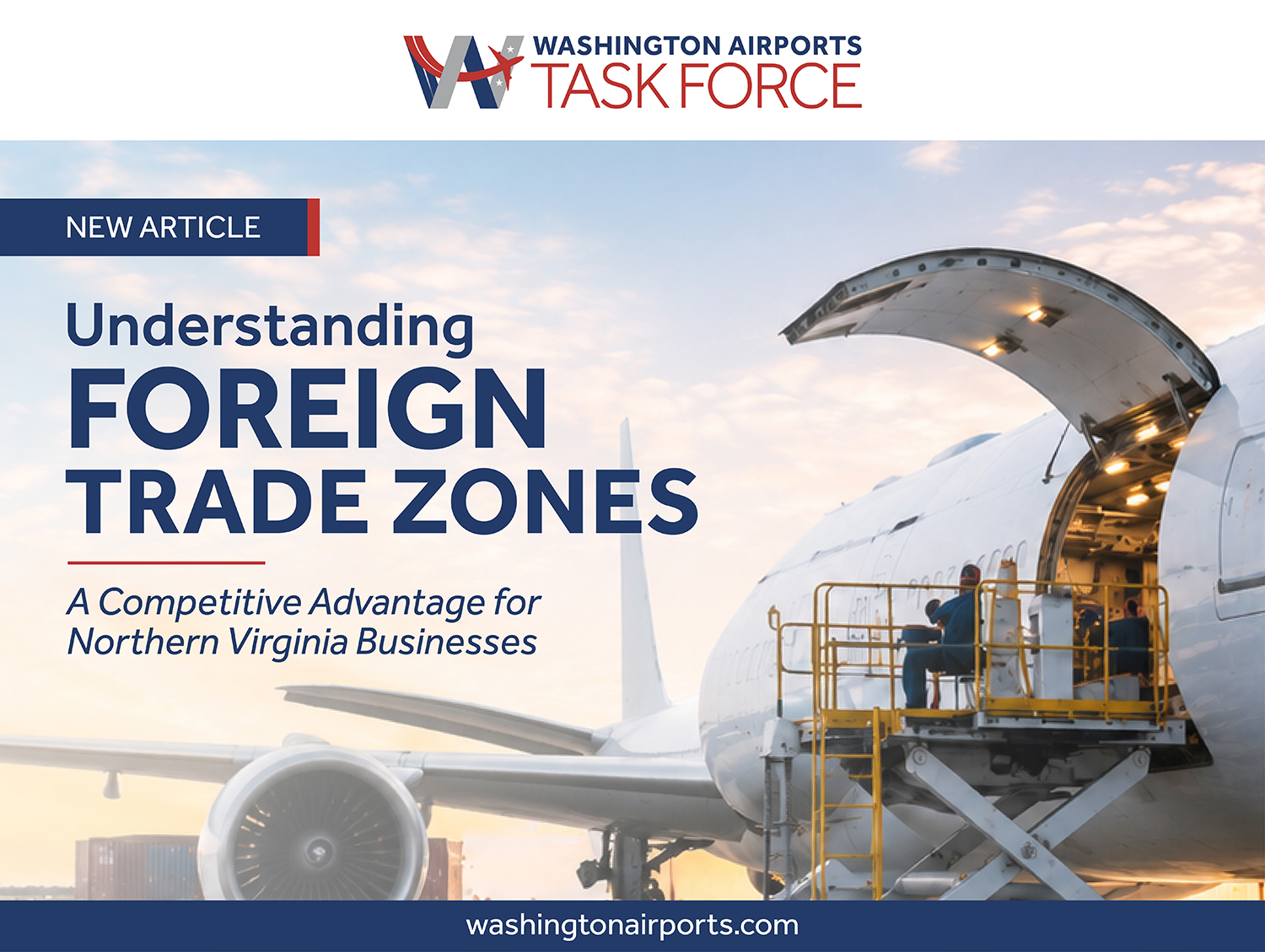
Understanding Foreign Trade Zones: A Competitive Advantage for Northern Virginia Businesses

For Northern Virginia businesses engaged in international trade, there’s a powerful but underutilized tool that can provide significant competitive advantages: Foreign Trade Zones. If your company imports products, manufactures goods with foreign components, or exports to international markets, understanding Foreign Trade Zones (FTZs) could unlock substantial cost savings and operational efficiencies.

The Washington Airports Task Force administers Foreign Trade Zone #137, located at Washington Dulles International Airport, serving businesses across Frederick, Clarke, Loudoun, Fairfax, Fauquier, Prince William, and Arlington counties, plus the City of Alexandria. Here’s what every Northern Virginia business leader should know about this economic development tool.

What is a Foreign Trade Zone?

The Foreign Trade Zones program was established by the FTZ Act of 1934 during the Great Depression. The program’s original purpose—and its mission today—is to provide a competitive advantage for companies with locations on U.S. soil by offering savings on Customs duties.

In the 1930s, American companies faced a challenge: labor and operating costs were lower abroad, creating pressure to move operations offshore. The FTZ program addressed this by removing certain financial disincentives associated with manufacturing in the United States. By providing duty savings, the program encouraged companies to maintain and grow their businesses in America rather than relocating to foreign countries.

Nearly 90 years later, in an even more globalized economy, the FTZ program remains highly relevant. Approval for FTZ designation is given by the FTZ Board, an independent agency within the U.S. Department of Commerce.

How Foreign Trade Zones Work

The mechanics of FTZs center on three key benefits: duty deferral, duty reduction, and duty elimination.

Duty Deferral

When foreign merchandise enters a Foreign Trade Zone, Customs duties are not immediately due. Companies can store, manufacture, or process goods within the FTZ without paying duties until—and unless—the merchandise enters U.S. commerce.

This creates significant cash flow advantages. Instead of paying duties upon importation and tying up capital, businesses can defer payment until goods are actually sold into the U.S. market. For companies with high inventory turnover or extended manufacturing cycles, this deferral can translate into substantial working capital savings.

Duty on machinery and equipment is deferred until it’s put into production. There’s no duty paid on goods that are re-exported or on scrap and damaged merchandise.

Duty Reduction (Inverted Tariff Relief)

One of the most powerful FTZ benefits addresses a competitive imbalance in the tariff system. When a product is manufactured abroad and imported to the U.S., duty is paid at the rate of the finished product. However, when a U.S.-based manufacturer imports components to assemble a finished product, duties are typically paid on each component—which can result in higher overall duty costs than the finished product would carry.

This puts U.S. manufacturers at a disadvantage compared to foreign competitors. FTZs correct this imbalance.

Within an FTZ, companies can choose to pay duty either on the foreign components used in manufacturing or on the finished product—whichever rate is lower. This is called “inverted tariff” relief. When the duty rate on the finished product is lower than the combined rates on imported components, FTZ users pay the lower rate, leveling the playing field with offshore manufacturers.

Duty Elimination

If merchandise admitted to an FTZ is subsequently exported from the United States, no Customs duties are ever paid. This is particularly valuable for:

  • Companies that import components, assemble products, and export finished goods
  • Distribution centers serving international markets
  • Businesses that import goods for processing before re-export
  • Companies that discover defective or damaged merchandise and choose to return it to suppliers abroad

Additionally, goods that are broken, scrapped, or destroyed within the FTZ are not subject to duty, providing savings when inventory becomes obsolete or damaged.

Who Benefits from Foreign Trade Zones?

Any company that imports products into the United States and performs certain operations could qualify for the FTZ program. According to federal regulations, merchandise in a zone can be:

  • Assembled
  • Cleaned
  • Displayed
  • Destroyed
  • Exhibited
  • Manipulated
  • Manufactured
  • Mixed
  • Processed
  • Relabeled
  • Repackaged
  • Repaired
  • Salvaged
  • Sampled
  • Stored
  • Tested

Industries That Commonly Use FTZs

  • Manufacturing: Companies that import components or raw materials for production benefit from inverted tariff relief and duty deferral on work-in-process inventory.
  • Distribution and Warehousing: Importers who store goods before distribution can defer duties until products enter U.S. commerce, improving cash flow.
  • Assembly Operations: Businesses that assemble finished products from foreign components can choose the most advantageous duty rate.
  • Export-Oriented Businesses: Companies that import materials for products ultimately destined for export markets can avoid duties entirely.
  • Technology and Electronics: Firms importing parts for assembly, testing, or repair operations benefit from multiple FTZ advantages.
  • Pharmaceuticals and Medical Devices: Companies importing active ingredients or components for processing can leverage duty savings.

When FTZ Benefits Are Most Significant

Foreign Trade Zones provide the greatest advantages when:

  • Your business involves testing, quality control, or inspection that may result in rejected or returned merchandise
  • Your company imports high-value merchandise subject to substantial duty rates
  • You maintain significant inventory that could benefit from duty deferral
  • Your manufacturing process creates an inverted tariff situation
  • You export a portion of imported goods
  • You file multiple Customs entries weekly (FTZs allow consolidated weekly entries rather than per-shipment processing)

WATF’s Role: Administering FTZ #137

The Washington Airports Task Force serves as the grantee and administrator of Foreign Trade Zone #137, located at Washington Dulles International Airport. The FTZ operates under the Alternative Site Framework (ASF), which provides greater flexibility when adding new zone operations and expedited FTZ Board applications.

Service Area

FTZ #137’s service area includes:

  • Frederick County
  • Clarke County
  • Loudoun County
  • Fairfax County
  • Fauquier County
  • Prince William County
  • Arlington County
  • City of Alexandria

This broad geographic coverage means businesses throughout Northern Virginia can access FTZ benefits, not just companies located at Dulles Airport.

Alternative Site Framework Advantage

In 2014, the FTZ Board modernized the program by introducing the Alternative Site Framework. FTZ #137 operates under this framework, which allows:

  • More efficient application processes for companies seeking FTZ designation
  • Faster approval timelines (30 days for minor boundary modifications)
  • Greater flexibility in designating new sites within the service area
  • Streamlined procedures for adding new FTZ users

This modern framework makes accessing FTZ benefits more practical for mid-sized businesses that might have found the traditional process too cumbersome.

WATF’s Mission Connection

Administering FTZ #137 aligns directly with WATF’s core mission: promoting economic development and job creation in Northern Virginia. By providing businesses with tools to compete more effectively in global markets, the FTZ program helps:

  • Leverage Dulles Airport’s international connectivity for economic advantage
  • Attract and retain companies that serve international markets
  • Support job creation in manufacturing, distribution, and logistics
  • Strengthen Northern Virginia’s position as a global business hub

How to Get Started with FTZ #137

If your Northern Virginia business could benefit from Foreign Trade Zone designation, here’s the process:

Step 1: Assess Your Potential Benefits

Evaluate whether FTZ benefits align with your business operations:

  • Calculate potential duty savings based on your import volume and tariff rates
  • Consider cash flow improvements from duty deferral
  • Assess administrative efficiencies from consolidated Customs processing
  • Determine if inverted tariff relief applies to your manufacturing processes

Step 2: Contact WATF

Reach out to the Washington Airports Task Force to discuss your company’s specific situation and FTZ eligibility.

Contact Information:

  • Washington Airports Task Force
  • 45005 Aviation Drive, Suite 130
  • Dulles, VA 20166
  • Visit: www.washingtonairports.com/foreign-trade-zone

WATF staff can provide guidance on:

  • Whether your operations qualify for FTZ benefits
  • The application process and timeline
  • Cost-benefit analysis specific to your business
  • Site designation requirements

Step 3: Federal Application Process

Once you’ve determined FTZ benefits are appropriate for your company:

  • Initial Consultation: Work with WATF as the zone grantee
  • Site Designation Application: WATF obtains comments from local U.S. Customs and Border Protection office
  • FTZ Board Submission: WATF submits your application to the Foreign Trade Zones Board
  • Approval Timeline: Under the Alternative Site Framework, minor boundary modifications are typically approved within 30 days

Step 4: Activation and Operations

After approval:

  • Implement FTZ procedures within your operations
  • Train staff on FTZ documentation and compliance requirements
  • Begin realizing duty savings, cash flow improvements, and operational efficiencies
  • Maintain compliance with FTZ regulations and Customs requirements

The Competitive Advantage

In today’s global economy, competitive advantages matter. Foreign Trade Zones provide tangible financial benefits that can improve a company’s bottom line while supporting American jobs and operations.

For Northern Virginia businesses, FTZ #137 offers proximity to Washington Dulles International Airport—one of the nation’s top 10 gateways—combined with access to international supply chains and markets. This combination of location and program benefits creates unique opportunities for companies serving global customers.

The FTZ program isn’t just about saving money on duties, though those savings can be substantial. It’s about creating a more level playing field for U.S.-based operations competing against foreign manufacturers, removing disincentives that might otherwise push companies to locate production offshore, and supporting regional economic development through smart policy tools.

Looking Forward

As Northern Virginia continues to attract technology companies, advanced manufacturers, and globally-oriented businesses, Foreign Trade Zone #137 will remain a valuable economic development asset. The program’s flexibility under the Alternative Site Framework makes it increasingly accessible to mid-sized companies, not just large multinational corporations.

The Washington Airports Task Force’s administration of FTZ #137 reflects the organization’s broader mission: leveraging aviation infrastructure and related programs to drive regional economic prosperity. Just as improved air service at Dulles and Reagan National airports creates connectivity and opportunity, the Foreign Trade Zone program creates financial advantages that help businesses compete and grow.

If your Northern Virginia business imports goods, manufactures products with foreign components, or serves international markets, exploring Foreign Trade Zone benefits could be one of the smartest strategic moves you make this year.


About WATF

The Washington Airports Task Force is a nonprofit, non-partisan 501(c)(3) organization that advocates for expanding and enhancing aviation services in Virginia and the National Capital Region. Since 1982, WATF has worked to promote job creation and economic growth through improved air service at Washington Dulles International Airport and Ronald Reagan Washington National Airport. To learn more, visit www.washingtonairports.com.

How WATF Has Shaped Northern Virginia’s Aviation Future

In 1982, business opportunities were literally flying by Northern Virginia. Washington Dulles International Airport was viewed as a wasted asset, and the region’s air service ranked among the worst in the nation. A visionary group of regional leaders decided it was time to “do something about Dulles Airport.”

More than four decades later, that decision transformed the National Capital Region’s aviation landscape and economic trajectory. Today, that visionary group is known as the Washington Airports Task Force (WATF), a nonprofit, non-partisan 501(c)(3) Virginia corporation dedicated to promoting aviation expansion for Virginia and the National Capital Region.

The Founding Vision: 1982

The Washington Airports Task Force was established in 1982 under the leadership of Carrington Williams, who served as founding chairman until 1996. The mission was straightforward but ambitious: advocate for improved air service at Washington Dulles International Airport to drive regional economic development and job creation.

At the time, Northern Virginia faced significant challenges. Dulles Airport was underutilized, international connectivity was limited, and the region’s economic competitiveness suffered as a result. Business leaders recognized that without robust aviation infrastructure, the region would continue to lose economic opportunities to better-connected metropolitan areas.

The founding principle was simple: improved air service equals economic prosperity. Regional leaders understood that companies seeking to serve global markets require locations with optimal airport access. This insight would guide WATF’s advocacy work for decades to come.

From “Worst to Best”: Transforming Regional Air Service

WATF’s advocacy efforts helped transform Washington’s air service from being among the worst in the nation to being among the best. This dramatic improvement didn’t happen overnight—it required sustained advocacy, strategic partnerships, and data-driven policy recommendations.

The organization worked closely with the Metropolitan Washington Airports Authority (MWAA), airlines, regional economic development authorities, and elected officials to make the case for expanded aviation services. WATF’s non-partisan, data-driven approach established the organization as a credible voice in regional transportation and economic development conversations.

Washington Dulles International Airport grew to become one of the top 10 gateways in the United States. The global reach created through international air service helped make Washington America’s largest technology center. Meanwhile, Ronald Reagan Washington National Airport continued serving as a critical domestic gateway, providing point-to-point connectivity for business and leisure travelers throughout the region.

The Williams Trophy Legacy: Recognizing Aviation Excellence

In 1996, WATF established the Williams Trophy to honor its founding chairman, Carrington Williams, who received the first trophy on June 10, 1996. The award recognizes individuals and organizations whose “Leadership, Vision and Dedication in the Application of Aviation or Space Enriched the Quality of Life on Earth.”

The Williams Trophy has become a prestigious honor in the aviation community, presented annually during WATF’s Annual General Meeting. Recent recipients include:

  • 2025: Boom Supersonic, Electra, and Joby Aviation (advancing state-of-the-art aviation technologies)
  • 2024: Women in Space and Aviation (honoring pioneers including Ellen Ochoa, Angela Gittens, Candace McGraw, Col. Pam Melroy, and Katelyn Miller)
  • 2023: Doug Parker, former Chairman and CEO of American Airlines
  • 2022: Silver Line Metrorail partnership (and Loudoun Counties, Town of Herndon, MWAA, and WMATA)

The Williams Trophy represents more than individual achievement—it reflects WATF’s commitment to recognizing the leaders and innovations that advance aviation and improve quality of life.

Key Milestones and Advocacy Wins

Throughout its history, WATF has achieved significant advocacy milestones that shaped Northern Virginia’s aviation infrastructure:

Transportation Connectivity

WATF championed multimodal transportation access to Washington’s airports. The organization’s advocacy contributed to the realization of the Silver Line Metro extension to Dulles, fulfilling a 62-year vision of connecting Dulles by rail to the National Capital Region. This achievement, honored with the 2022 Williams Trophy, transformed airport accessibility and reduced highway congestion.

Reagan National Airport benefited from existing Metro connectivity via the Blue and Yellow lines, and WATF continues advocating for transportation improvements that serve both regional airports.

Economic Development Partnerships

WATF forged strong partnerships with regional economic development authorities, including Fairfax County, Loudoun Economic Development, Prince William County Department of Economic Development, and the Town of Herndon. These partnerships ensure coordinated strategies that leverage aviation infrastructure for regional growth.

Foreign Trade Zone Administration

WATF administers a Foreign Trade Zone in Northern Virginia, providing cost advantages for companies engaged in international trade. This program encourages U.S.-based operations by allowing businesses to defer, reduce, or eliminate Customs duties, strengthening the region’s competitiveness in global markets.

Community Investment

Through the Committee for Dulles Community Outreach (CFDCO), WATF has invested in the next generation of aviation professionals. Since 2012, CFDCO has awarded 313 scholarships totaling $475,000 to graduating high school seniors pursuing careers in aviation, aerospace, and related fields.

The annual Dulles 5K/10K Runway Race, now in its second decade, provides a unique community engagement opportunity while raising awareness of aviation’s role in the region.

Regional Impact: Connecting Aviation to Economic Prosperity

WATF’s advocacy work is grounded in a fundamental belief: airports are economic infrastructure, not just transportation facilities.

Washington Dulles International Airport and Ronald Reagan Washington National Airport serve as critical engines for Northern Virginia’s economy. They enable international business connections, attract foreign investment, support tourism, and create thousands of direct and indirect jobs. The global connectivity provided by these airports has been instrumental in establishing Northern Virginia as one of the nation’s most prosperous regions.

WATF’s 60-member Board of Directors comprises regional business leaders who understand this connection intimately. Their guidance ensures WATF remains focused on measurable outcomes that benefit the entire region.

Evolving Priorities: Supporting Both Regional Airports

While WATF’s founding mission focused on “doing something about Dulles Airport,” the organization’s scope has evolved to support both Washington Dulles International Airport and Ronald Reagan Washington National Airport.

Today, WATF advocates for:

  • Air service expansion at Dulles to strengthen international gateway capabilities
  • Support for constrained services at Reagan National while respecting operational limitations
  • Robust inter-Virginia airport air service connectivity
  • Regional transportation improvements that enhance access to both airports
  • Sustainable aviation growth that balances economic benefits with environmental responsibility

This dual-airport focus reflects WATF’s understanding that both gateways play essential, complementary roles in regional connectivity and economic competitiveness.

The Next Chapter: Challenges and Opportunities

As WATF looks toward its next decades of advocacy, several priorities emerge:

  • Infrastructure Investment: Both Dulles and Reagan National require continued investment in terminal modernization, capacity optimization, and ground transportation access to remain competitive with peer gateway airports.
  • Workforce Development: The aviation industry faces workforce challenges including pilot shortages and maintenance technician demand. WATF supports initiatives that prepare the next generation of aviation professionals.
  • Sustainable Growth: Balancing aviation expansion with environmental responsibility remains a critical priority as the industry evolves toward more sustainable practices.
  • Regional Competitiveness: Other metropolitan areas are aggressively pursuing air service development and infrastructure improvements. WATF’s advocacy ensures Northern Virginia maintains its competitive position.

A Legacy of Vision and Impact

From a group of regional leaders who decided to “do something about Dulles Airport” in 1982, WATF has evolved into a respected voice for aviation advocacy across the National Capital Region. The organization’s non-partisan, data-driven approach has earned credibility with policymakers, industry stakeholders, and community partners.

The transformation is measurable: Washington’s airports evolved from underutilized assets to top-tier gateways serving millions of passengers annually. The region’s economy has grown in tandem, attracting technology companies, international businesses, and talent from around the world.

This success didn’t happen by accident. It required sustained advocacy, strategic partnerships, and unwavering commitment to a vision that connects aviation infrastructure to economic prosperity.

As WATF enters its fifth decade of advocacy, the mission remains clear: promote the expansion and enhancement of aviation services for Virginia and the National Capital Region to stimulate job creation and economic growth. The next 40 years will bring new challenges and opportunities, but WATF’s founding principle endures—improved air service equals economic prosperity for Northern Virginia.


About WATF

The Washington Airports Task Force is a nonprofit, non-partisan 501(c)(3) organization that advocates for expanding and enhancing aviation services in Virginia and the National Capital Region. Since 1982, WATF has worked to promote job creation and economic growth through improved air service at Washington Dulles International Airport and Ronald Reagan Washington National Airport. To learn more, visit www.washingtonairports.com.

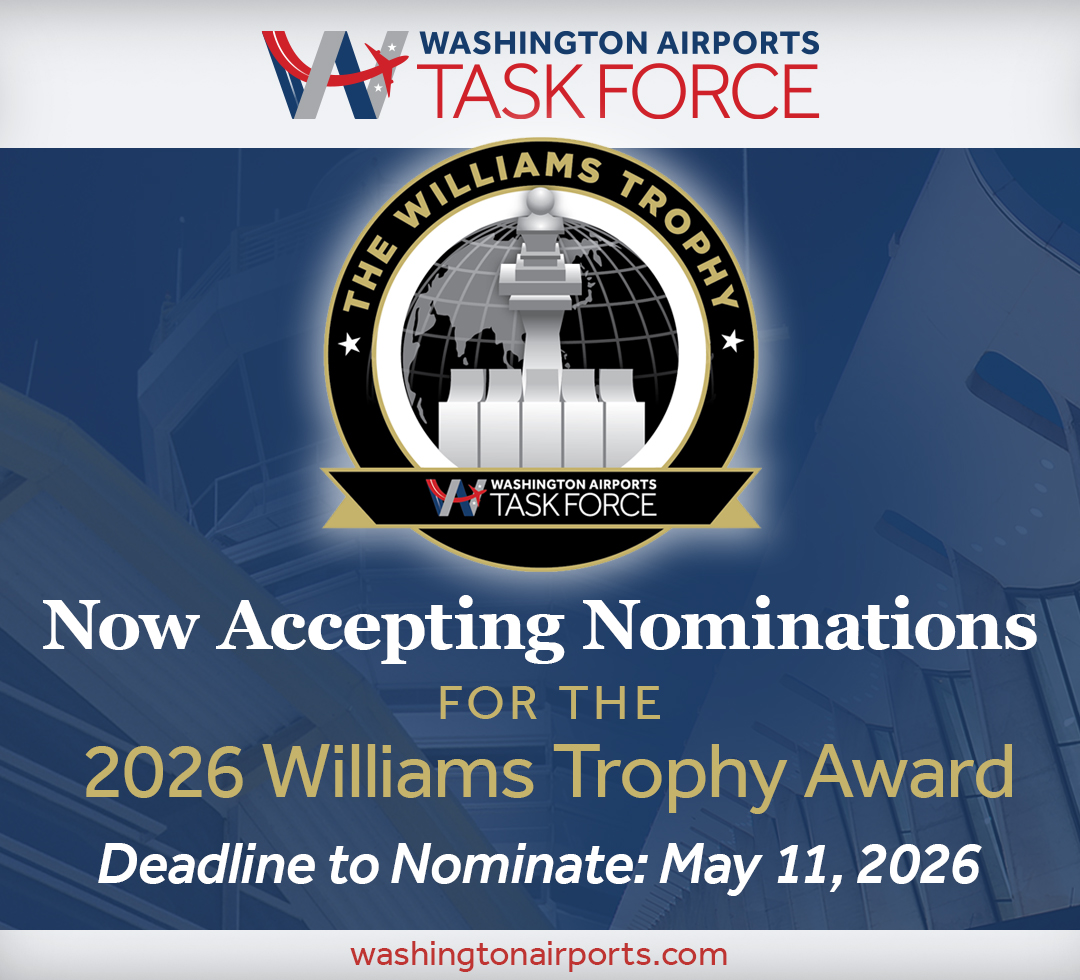
2026 Williams Trophy Award Nominations

Now Boarding  – Submit Your 2026 Williams Trophy Award Nominations

The Washington Airports Task Force is gaining altitude as we rally our network, community, and aviation enthusiasts to submit nominations for the 2026 Williams Trophy Awards. This is your chance to help recognize the leaders and innovators shaping the future of aviation and space. Now in its 30th year, the Williams Trophy continues to stand as one of the industry’s most prestigious and inspiring honors.

Established in 1996 by the WATF Board of Directors, the award celebrates the legacy of Carrington Williams, the organization’s founding chairman (1982–1996) and its first recipient. The Williams Trophy recognizes those whose “Leadership, Vision and Dedication in the Application of Aviation or Space Enrich the Quality of Life on Earth,” while advancing a forward-looking vision and an unwavering commitment to aviation and the human connections it brings together.

Your nomination does more than spotlight excellence—it helps shape the story of the year. From influencing the selection of this year’s recipient(s) to inspiring the theme of WATF’s Annual General Meeting (AGM), your voice plays a key role in one of our most anticipated events. The 2026 AGM, taking place later this year, is expected to once again bring together a full and energized audience to celebrate the very best of our industry.

Do you know an individual, organization, or breakthrough worthy of this recognition? Submit your nomination by answering three simple questions here. The deadline is May 11, 2026—don’t miss the opportunity to help spotlight excellence and fly the future forward.

View past recipients here.

Questions? Reach out anytime at [email protected].

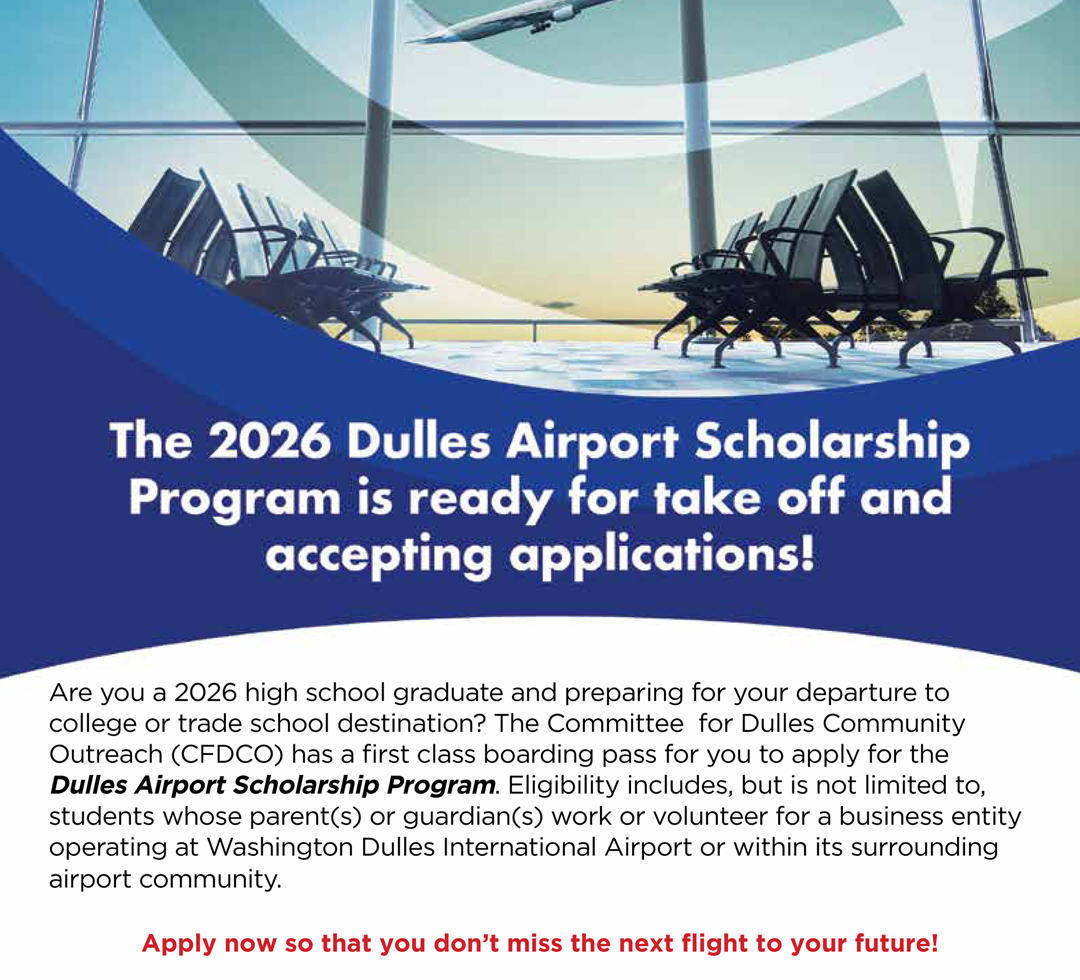
2026 CFDCO Dulles Airport Scholarship Program

Buckle up your seatbelts…

The Committee for Dulles Community Outreach (CFDCO) is now accepting applications for its 2026 Dulles Airport Scholarship Program, which provides financial assistance to 2026 high school graduating students enrolling in accredited college, university or trade school.

“The rising costs of college and trade school continue to be one of the biggest obstacles to launching a successful career. The CFDCO Dulles Scholarship plays a vital role in empowering a group of talented future professionals, while alleviating some of the financial strain,” said Lisa Merhaut, President of CFDCO.

Eligibility is as follows: 

1. Applicant must be an employee or volunteer of, or the dependent of an employee or volunteer of, a business or agency operating in the Washington Dulles Airport community. (This is defined as inside the fence that surrounds the entire airport property.)

2. Applicant is a graduating high school senior (Class of 2026).

3. Applicant must enroll in an accredited community college, trade school, college, or university.  The applicant may be full-time or part-time.

4. Applicant demonstrates leadership and commitment to the community through involvement in extracurricular, community and/or volunteer activities. 

6. No financial disclosure is required; scholarship is not based on need.

FOR MORE DETAILS ABOUT THE PROGRAM, click here.

TO APPLY ONLINE, click here. Applications must be submitted online by April 6, 2026, and include an essay, academic transcripts, and a letter of recommendation. By supporting tuition and other expenses, the scholarship continues to advance its core value of strengthening the ability to support students while expanding access to educational resources. Since 2012, 313 scholarships totaling $475,000 to graduating high school seniors who work/volunteer or have parents who work/volunteer within Dulles Airport’s perimeter. In addition, $59,000 in grants to local organizations that support the airport and Dulles Aiport passengers, including travelers aid operations and the interfaith chapel.

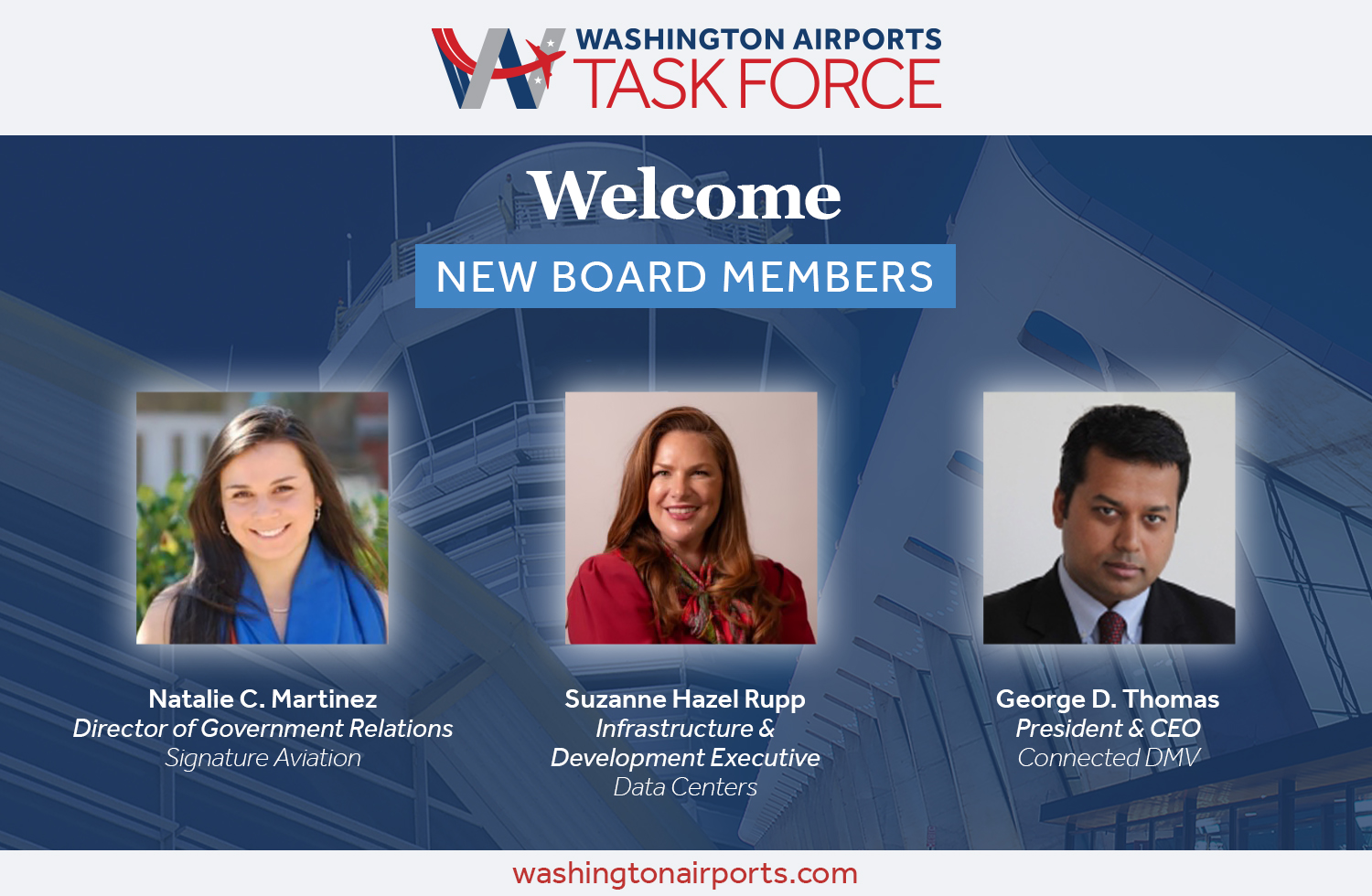
New Board Members: The Washington Airports Task Force Welcomes Natalie C. Martinez, Suzanne Hazel Rupp, and George D. Thomas

We are pleased to welcome Natalie C. Martinez, Suzanne Hazel Rupp and George D. Thomas to the Board of Directors of the Washington Airports Task Force (WATF). As we continue to advance our mission of fostering economic growth and innovation in the aviation sector, the addition of these distinguished leaders will provide invaluable insights and expertise to our organization.

We look forward to collaborating with them on key initiatives aimed at strengthening the aviation sector within the Commonwealth of Virginia and the broader National Capital Region. Together, we will continue to drive the development of sustainable growth, improved infrastructure, and stronger partnerships in the industry.

Thank you for your commitment to WATF’s mission, and we are excited to see the impact of your contributions in the years ahead.