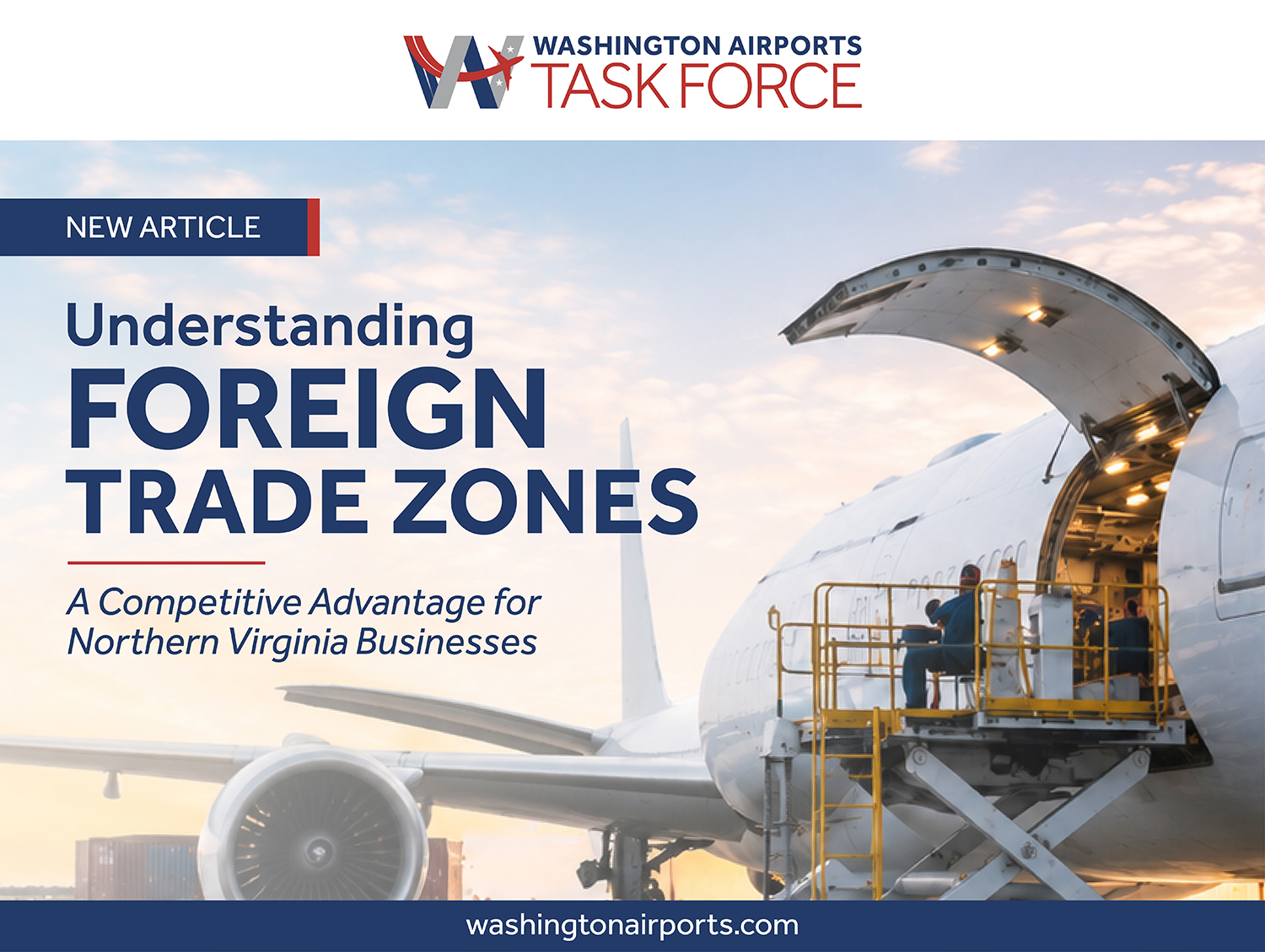
Understanding Foreign Trade Zones: A Competitive Advantage for Northern Virginia Businesses

For Northern Virginia businesses engaged in international trade, there’s a powerful but underutilized tool that can provide significant competitive advantages: Foreign Trade Zones. If your company imports products, manufactures goods with foreign components, or exports to international markets, understanding Foreign Trade Zones (FTZs) could unlock substantial cost savings and operational efficiencies.

The Washington Airports Task Force administers Foreign Trade Zone #137, located at Washington Dulles International Airport, serving businesses across Frederick, Clarke, Loudoun, Fairfax, Fauquier, Prince William, and Arlington counties, plus the City of Alexandria. Here’s what every Northern Virginia business leader should know about this economic development tool.

What is a Foreign Trade Zone?

The Foreign Trade Zones program was established by the FTZ Act of 1934 during the Great Depression. The program’s original purpose—and its mission today—is to provide a competitive advantage for companies with locations on U.S. soil by offering savings on Customs duties.

In the 1930s, American companies faced a challenge: labor and operating costs were lower abroad, creating pressure to move operations offshore. The FTZ program addressed this by removing certain financial disincentives associated with manufacturing in the United States. By providing duty savings, the program encouraged companies to maintain and grow their businesses in America rather than relocating to foreign countries.

Nearly 90 years later, in an even more globalized economy, the FTZ program remains highly relevant. Approval for FTZ designation is given by the FTZ Board, an independent agency within the U.S. Department of Commerce.

How Foreign Trade Zones Work

The mechanics of FTZs center on three key benefits: duty deferral, duty reduction, and duty elimination.

Duty Deferral

When foreign merchandise enters a Foreign Trade Zone, Customs duties are not immediately due. Companies can store, manufacture, or process goods within the FTZ without paying duties until—and unless—the merchandise enters U.S. commerce.

This creates significant cash flow advantages. Instead of paying duties upon importation and tying up capital, businesses can defer payment until goods are actually sold into the U.S. market. For companies with high inventory turnover or extended manufacturing cycles, this deferral can translate into substantial working capital savings.

Duty on machinery and equipment is deferred until it’s put into production. There’s no duty paid on goods that are re-exported or on scrap and damaged merchandise.

Duty Reduction (Inverted Tariff Relief)

One of the most powerful FTZ benefits addresses a competitive imbalance in the tariff system. When a product is manufactured abroad and imported to the U.S., duty is paid at the rate of the finished product. However, when a U.S.-based manufacturer imports components to assemble a finished product, duties are typically paid on each component—which can result in higher overall duty costs than the finished product would carry.

This puts U.S. manufacturers at a disadvantage compared to foreign competitors. FTZs correct this imbalance.

Within an FTZ, companies can choose to pay duty either on the foreign components used in manufacturing or on the finished product—whichever rate is lower. This is called “inverted tariff” relief. When the duty rate on the finished product is lower than the combined rates on imported components, FTZ users pay the lower rate, leveling the playing field with offshore manufacturers.

Duty Elimination

If merchandise admitted to an FTZ is subsequently exported from the United States, no Customs duties are ever paid. This is particularly valuable for:

  • Companies that import components, assemble products, and export finished goods
  • Distribution centers serving international markets
  • Businesses that import goods for processing before re-export
  • Companies that discover defective or damaged merchandise and choose to return it to suppliers abroad

Additionally, goods that are broken, scrapped, or destroyed within the FTZ are not subject to duty, providing savings when inventory becomes obsolete or damaged.

Who Benefits from Foreign Trade Zones?

Any company that imports products into the United States and performs certain operations could qualify for the FTZ program. According to federal regulations, merchandise in a zone can be:

  • Assembled
  • Cleaned
  • Displayed
  • Destroyed
  • Exhibited
  • Manipulated
  • Manufactured
  • Mixed
  • Processed
  • Relabeled
  • Repackaged
  • Repaired
  • Salvaged
  • Sampled
  • Stored
  • Tested

Industries That Commonly Use FTZs

  • Manufacturing: Companies that import components or raw materials for production benefit from inverted tariff relief and duty deferral on work-in-process inventory.
  • Distribution and Warehousing: Importers who store goods before distribution can defer duties until products enter U.S. commerce, improving cash flow.
  • Assembly Operations: Businesses that assemble finished products from foreign components can choose the most advantageous duty rate.
  • Export-Oriented Businesses: Companies that import materials for products ultimately destined for export markets can avoid duties entirely.
  • Technology and Electronics: Firms importing parts for assembly, testing, or repair operations benefit from multiple FTZ advantages.
  • Pharmaceuticals and Medical Devices: Companies importing active ingredients or components for processing can leverage duty savings.

When FTZ Benefits Are Most Significant

Foreign Trade Zones provide the greatest advantages when:

  • Your business involves testing, quality control, or inspection that may result in rejected or returned merchandise
  • Your company imports high-value merchandise subject to substantial duty rates
  • You maintain significant inventory that could benefit from duty deferral
  • Your manufacturing process creates an inverted tariff situation
  • You export a portion of imported goods
  • You file multiple Customs entries weekly (FTZs allow consolidated weekly entries rather than per-shipment processing)

WATF’s Role: Administering FTZ #137

The Washington Airports Task Force serves as the grantee and administrator of Foreign Trade Zone #137, located at Washington Dulles International Airport. The FTZ operates under the Alternative Site Framework (ASF), which provides greater flexibility when adding new zone operations and expedited FTZ Board applications.

Service Area

FTZ #137’s service area includes:

  • Frederick County
  • Clarke County
  • Loudoun County
  • Fairfax County
  • Fauquier County
  • Prince William County
  • Arlington County
  • City of Alexandria

This broad geographic coverage means businesses throughout Northern Virginia can access FTZ benefits, not just companies located at Dulles Airport.

Alternative Site Framework Advantage

In 2014, the FTZ Board modernized the program by introducing the Alternative Site Framework. FTZ #137 operates under this framework, which allows:

  • More efficient application processes for companies seeking FTZ designation
  • Faster approval timelines (30 days for minor boundary modifications)
  • Greater flexibility in designating new sites within the service area
  • Streamlined procedures for adding new FTZ users

This modern framework makes accessing FTZ benefits more practical for mid-sized businesses that might have found the traditional process too cumbersome.

WATF’s Mission Connection

Administering FTZ #137 aligns directly with WATF’s core mission: promoting economic development and job creation in Northern Virginia. By providing businesses with tools to compete more effectively in global markets, the FTZ program helps:

  • Leverage Dulles Airport’s international connectivity for economic advantage
  • Attract and retain companies that serve international markets
  • Support job creation in manufacturing, distribution, and logistics
  • Strengthen Northern Virginia’s position as a global business hub

How to Get Started with FTZ #137

If your Northern Virginia business could benefit from Foreign Trade Zone designation, here’s the process:

Step 1: Assess Your Potential Benefits

Evaluate whether FTZ benefits align with your business operations:

  • Calculate potential duty savings based on your import volume and tariff rates
  • Consider cash flow improvements from duty deferral
  • Assess administrative efficiencies from consolidated Customs processing
  • Determine if inverted tariff relief applies to your manufacturing processes

Step 2: Contact WATF

Reach out to the Washington Airports Task Force to discuss your company’s specific situation and FTZ eligibility.

Contact Information:

  • Washington Airports Task Force
  • 45005 Aviation Drive, Suite 130
  • Dulles, VA 20166
  • Visit: www.washingtonairports.com/foreign-trade-zone

WATF staff can provide guidance on:

  • Whether your operations qualify for FTZ benefits
  • The application process and timeline
  • Cost-benefit analysis specific to your business
  • Site designation requirements

Step 3: Federal Application Process

Once you’ve determined FTZ benefits are appropriate for your company:

  • Initial Consultation: Work with WATF as the zone grantee
  • Site Designation Application: WATF obtains comments from local U.S. Customs and Border Protection office
  • FTZ Board Submission: WATF submits your application to the Foreign Trade Zones Board
  • Approval Timeline: Under the Alternative Site Framework, minor boundary modifications are typically approved within 30 days

Step 4: Activation and Operations

After approval:

  • Implement FTZ procedures within your operations
  • Train staff on FTZ documentation and compliance requirements
  • Begin realizing duty savings, cash flow improvements, and operational efficiencies
  • Maintain compliance with FTZ regulations and Customs requirements

The Competitive Advantage

In today’s global economy, competitive advantages matter. Foreign Trade Zones provide tangible financial benefits that can improve a company’s bottom line while supporting American jobs and operations.

For Northern Virginia businesses, FTZ #137 offers proximity to Washington Dulles International Airport—one of the nation’s top 10 gateways—combined with access to international supply chains and markets. This combination of location and program benefits creates unique opportunities for companies serving global customers.

The FTZ program isn’t just about saving money on duties, though those savings can be substantial. It’s about creating a more level playing field for U.S.-based operations competing against foreign manufacturers, removing disincentives that might otherwise push companies to locate production offshore, and supporting regional economic development through smart policy tools.

Looking Forward

As Northern Virginia continues to attract technology companies, advanced manufacturers, and globally-oriented businesses, Foreign Trade Zone #137 will remain a valuable economic development asset. The program’s flexibility under the Alternative Site Framework makes it increasingly accessible to mid-sized companies, not just large multinational corporations.

The Washington Airports Task Force’s administration of FTZ #137 reflects the organization’s broader mission: leveraging aviation infrastructure and related programs to drive regional economic prosperity. Just as improved air service at Dulles and Reagan National airports creates connectivity and opportunity, the Foreign Trade Zone program creates financial advantages that help businesses compete and grow.

If your Northern Virginia business imports goods, manufactures products with foreign components, or serves international markets, exploring Foreign Trade Zone benefits could be one of the smartest strategic moves you make this year.


About WATF

The Washington Airports Task Force is a nonprofit, non-partisan 501(c)(3) organization that advocates for expanding and enhancing aviation services in Virginia and the National Capital Region. Since 1982, WATF has worked to promote job creation and economic growth through improved air service at Washington Dulles International Airport and Ronald Reagan Washington National Airport. To learn more, visit www.washingtonairports.com.

How WATF Has Shaped Northern Virginia’s Aviation Future

In 1982, business opportunities were literally flying by Northern Virginia. Washington Dulles International Airport was viewed as a wasted asset, and the region’s air service ranked among the worst in the nation. A visionary group of regional leaders decided it was time to “do something about Dulles Airport.”

More than four decades later, that decision transformed the National Capital Region’s aviation landscape and economic trajectory. Today, that visionary group is known as the Washington Airports Task Force (WATF), a nonprofit, non-partisan 501(c)(3) Virginia corporation dedicated to promoting aviation expansion for Virginia and the National Capital Region.

The Founding Vision: 1982

The Washington Airports Task Force was established in 1982 under the leadership of Carrington Williams, who served as founding chairman until 1996. The mission was straightforward but ambitious: advocate for improved air service at Washington Dulles International Airport to drive regional economic development and job creation.

At the time, Northern Virginia faced significant challenges. Dulles Airport was underutilized, international connectivity was limited, and the region’s economic competitiveness suffered as a result. Business leaders recognized that without robust aviation infrastructure, the region would continue to lose economic opportunities to better-connected metropolitan areas.

The founding principle was simple: improved air service equals economic prosperity. Regional leaders understood that companies seeking to serve global markets require locations with optimal airport access. This insight would guide WATF’s advocacy work for decades to come.

From “Worst to Best”: Transforming Regional Air Service

WATF’s advocacy efforts helped transform Washington’s air service from being among the worst in the nation to being among the best. This dramatic improvement didn’t happen overnight—it required sustained advocacy, strategic partnerships, and data-driven policy recommendations.

The organization worked closely with the Metropolitan Washington Airports Authority (MWAA), airlines, regional economic development authorities, and elected officials to make the case for expanded aviation services. WATF’s non-partisan, data-driven approach established the organization as a credible voice in regional transportation and economic development conversations.

Washington Dulles International Airport grew to become one of the top 10 gateways in the United States. The global reach created through international air service helped make Washington America’s largest technology center. Meanwhile, Ronald Reagan Washington National Airport continued serving as a critical domestic gateway, providing point-to-point connectivity for business and leisure travelers throughout the region.

The Williams Trophy Legacy: Recognizing Aviation Excellence

In 1996, WATF established the Williams Trophy to honor its founding chairman, Carrington Williams, who received the first trophy on June 10, 1996. The award recognizes individuals and organizations whose “Leadership, Vision and Dedication in the Application of Aviation or Space Enriched the Quality of Life on Earth.”

The Williams Trophy has become a prestigious honor in the aviation community, presented annually during WATF’s Annual General Meeting. Recent recipients include:

  • 2025: Boom Supersonic, Electra, and Joby Aviation (advancing state-of-the-art aviation technologies)
  • 2024: Women in Space and Aviation (honoring pioneers including Ellen Ochoa, Angela Gittens, Candace McGraw, Col. Pam Melroy, and Katelyn Miller)
  • 2023: Doug Parker, former Chairman and CEO of American Airlines
  • 2022: Silver Line Metrorail partnership (and Loudoun Counties, Town of Herndon, MWAA, and WMATA)

The Williams Trophy represents more than individual achievement—it reflects WATF’s commitment to recognizing the leaders and innovations that advance aviation and improve quality of life.

Key Milestones and Advocacy Wins

Throughout its history, WATF has achieved significant advocacy milestones that shaped Northern Virginia’s aviation infrastructure:

Transportation Connectivity

WATF championed multimodal transportation access to Washington’s airports. The organization’s advocacy contributed to the realization of the Silver Line Metro extension to Dulles, fulfilling a 62-year vision of connecting Dulles by rail to the National Capital Region. This achievement, honored with the 2022 Williams Trophy, transformed airport accessibility and reduced highway congestion.

Reagan National Airport benefited from existing Metro connectivity via the Blue and Yellow lines, and WATF continues advocating for transportation improvements that serve both regional airports.

Economic Development Partnerships

WATF forged strong partnerships with regional economic development authorities, including Fairfax County, Loudoun Economic Development, Prince William County Department of Economic Development, and the Town of Herndon. These partnerships ensure coordinated strategies that leverage aviation infrastructure for regional growth.

Foreign Trade Zone Administration

WATF administers a Foreign Trade Zone in Northern Virginia, providing cost advantages for companies engaged in international trade. This program encourages U.S.-based operations by allowing businesses to defer, reduce, or eliminate Customs duties, strengthening the region’s competitiveness in global markets.

Community Investment

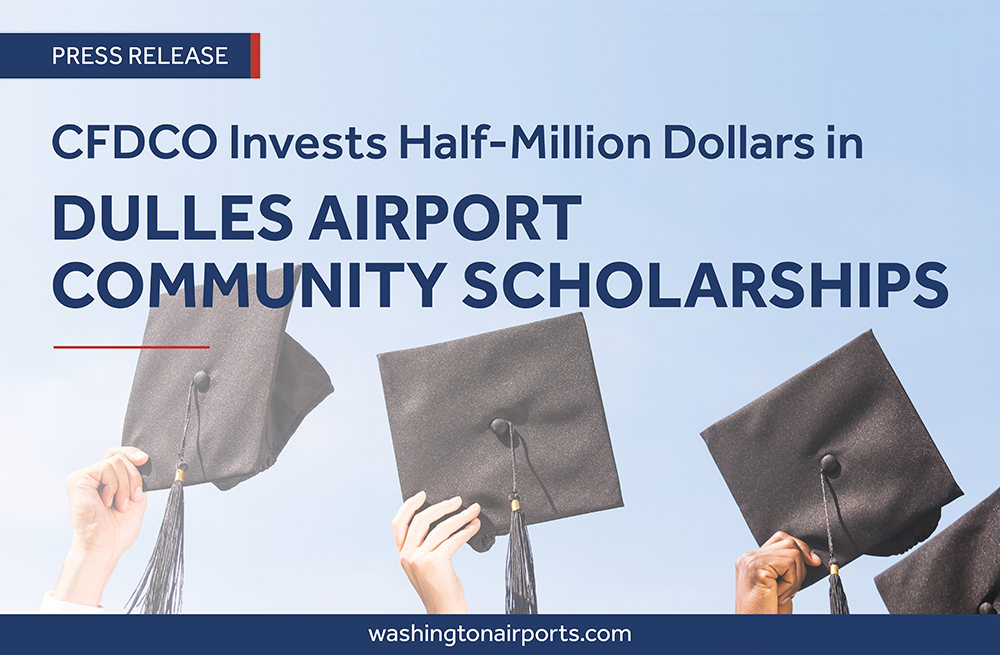
Through the Committee for Dulles Community Outreach (CFDCO), WATF has invested in the next generation of aviation professionals. Since 2012, CFDCO has awarded 313 scholarships totaling $475,000 to graduating high school seniors pursuing careers in aviation, aerospace, and related fields.

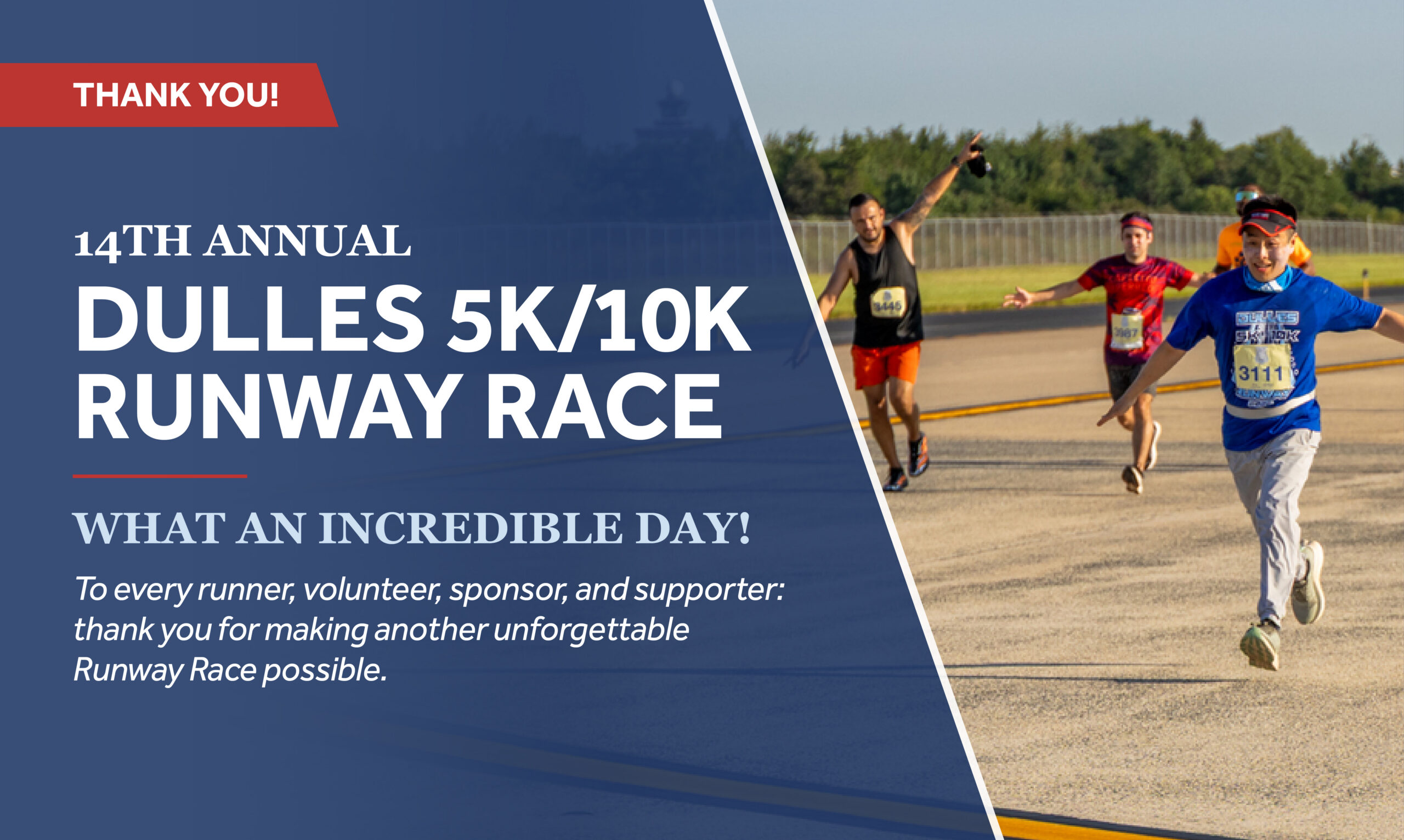
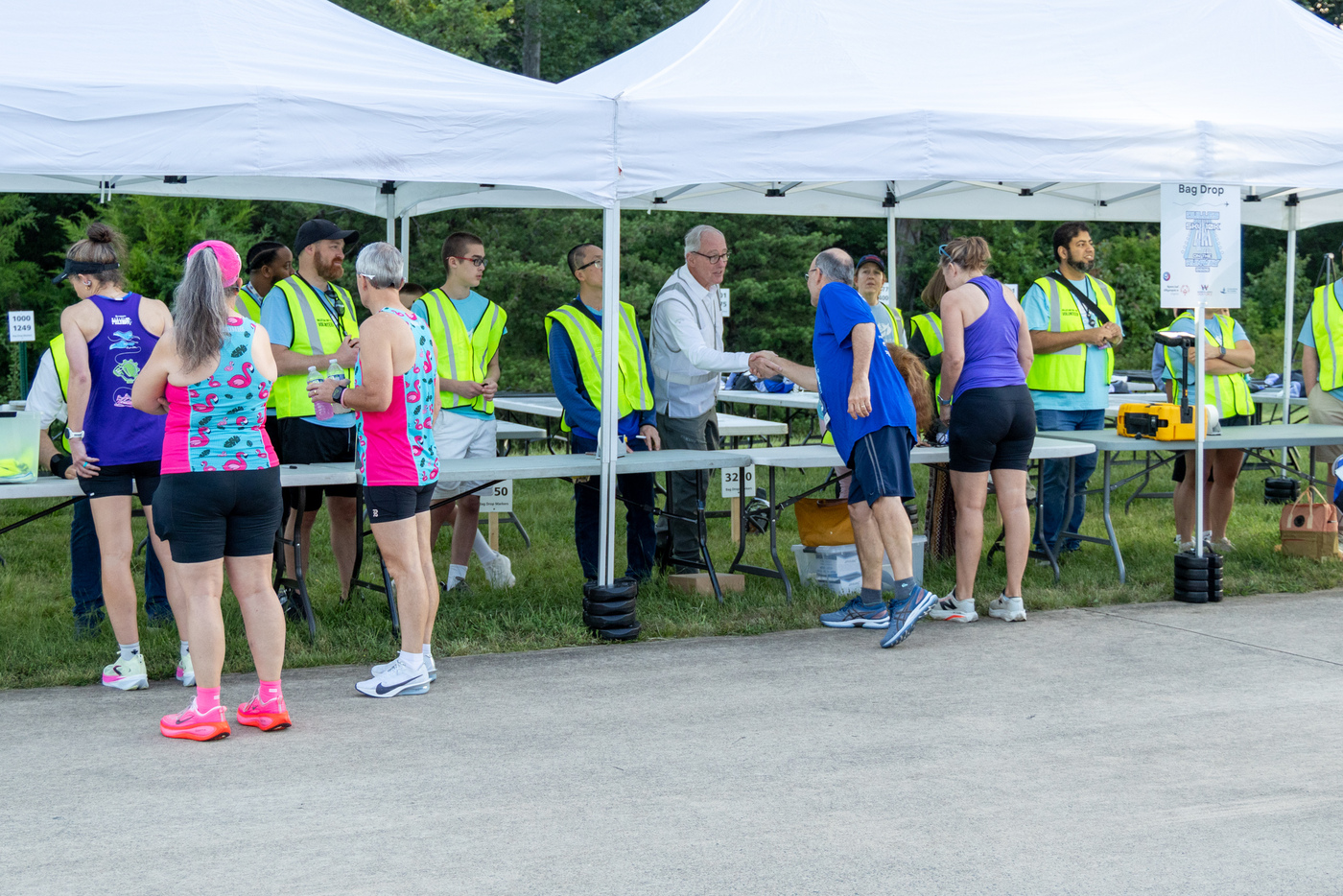
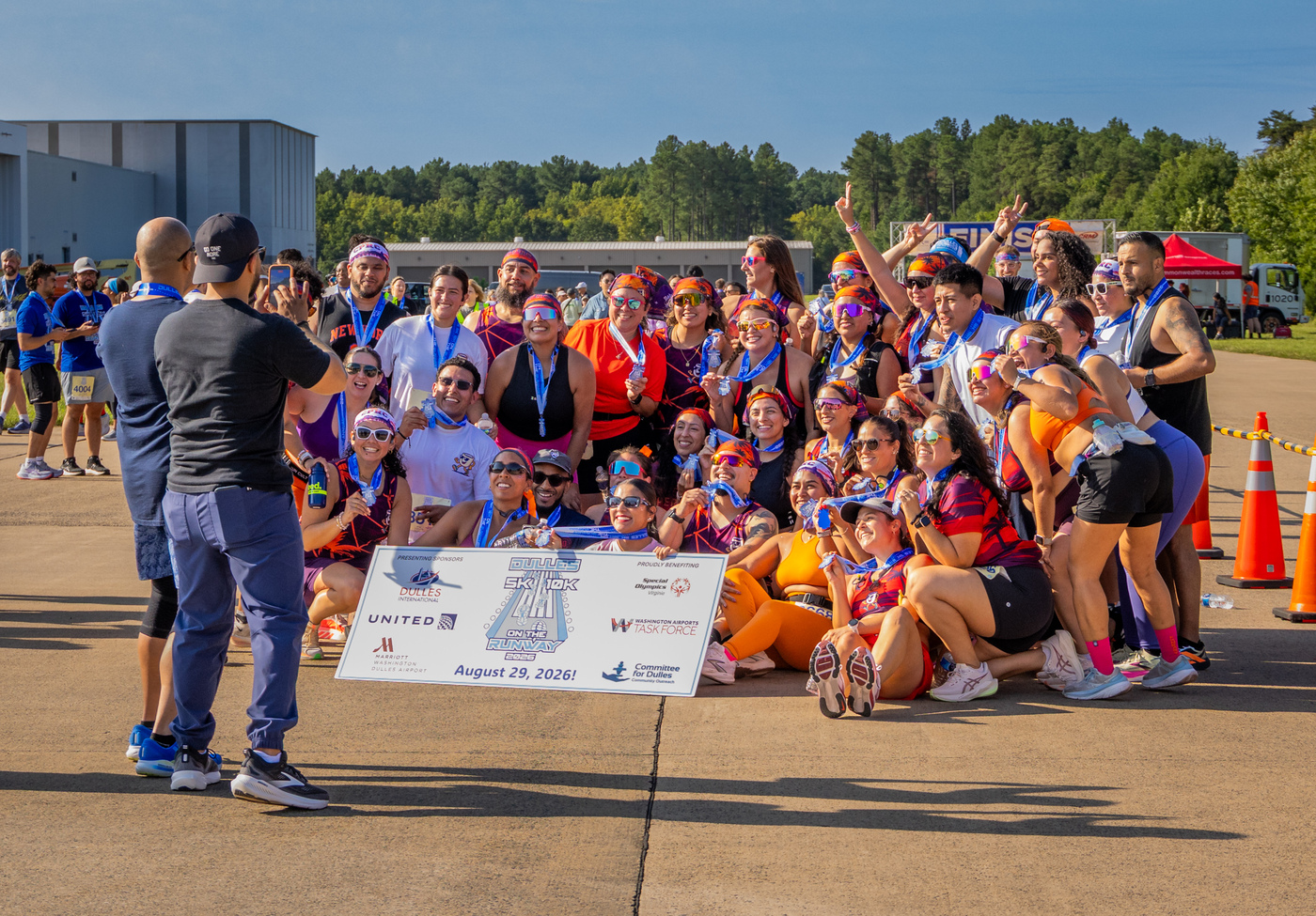
The annual Dulles 5K/10K Runway Race, now in its second decade, provides a unique community engagement opportunity while raising awareness of aviation’s role in the region.

Regional Impact: Connecting Aviation to Economic Prosperity

WATF’s advocacy work is grounded in a fundamental belief: airports are economic infrastructure, not just transportation facilities.

Washington Dulles International Airport and Ronald Reagan Washington National Airport serve as critical engines for Northern Virginia’s economy. They enable international business connections, attract foreign investment, support tourism, and create thousands of direct and indirect jobs. The global connectivity provided by these airports has been instrumental in establishing Northern Virginia as one of the nation’s most prosperous regions.

WATF’s 60-member Board of Directors comprises regional business leaders who understand this connection intimately. Their guidance ensures WATF remains focused on measurable outcomes that benefit the entire region.

Evolving Priorities: Supporting Both Regional Airports

While WATF’s founding mission focused on “doing something about Dulles Airport,” the organization’s scope has evolved to support both Washington Dulles International Airport and Ronald Reagan Washington National Airport.

Today, WATF advocates for:

  • Air service expansion at Dulles to strengthen international gateway capabilities
  • Support for constrained services at Reagan National while respecting operational limitations
  • Robust inter-Virginia airport air service connectivity
  • Regional transportation improvements that enhance access to both airports
  • Sustainable aviation growth that balances economic benefits with environmental responsibility

This dual-airport focus reflects WATF’s understanding that both gateways play essential, complementary roles in regional connectivity and economic competitiveness.

The Next Chapter: Challenges and Opportunities

As WATF looks toward its next decades of advocacy, several priorities emerge:

  • Infrastructure Investment: Both Dulles and Reagan National require continued investment in terminal modernization, capacity optimization, and ground transportation access to remain competitive with peer gateway airports.
  • Workforce Development: The aviation industry faces workforce challenges including pilot shortages and maintenance technician demand. WATF supports initiatives that prepare the next generation of aviation professionals.
  • Sustainable Growth: Balancing aviation expansion with environmental responsibility remains a critical priority as the industry evolves toward more sustainable practices.
  • Regional Competitiveness: Other metropolitan areas are aggressively pursuing air service development and infrastructure improvements. WATF’s advocacy ensures Northern Virginia maintains its competitive position.

A Legacy of Vision and Impact

From a group of regional leaders who decided to “do something about Dulles Airport” in 1982, WATF has evolved into a respected voice for aviation advocacy across the National Capital Region. The organization’s non-partisan, data-driven approach has earned credibility with policymakers, industry stakeholders, and community partners.

The transformation is measurable: Washington’s airports evolved from underutilized assets to top-tier gateways serving millions of passengers annually. The region’s economy has grown in tandem, attracting technology companies, international businesses, and talent from around the world.

This success didn’t happen by accident. It required sustained advocacy, strategic partnerships, and unwavering commitment to a vision that connects aviation infrastructure to economic prosperity.

As WATF enters its fifth decade of advocacy, the mission remains clear: promote the expansion and enhancement of aviation services for Virginia and the National Capital Region to stimulate job creation and economic growth. The next 40 years will bring new challenges and opportunities, but WATF’s founding principle endures—improved air service equals economic prosperity for Northern Virginia.


About WATF

The Washington Airports Task Force is a nonprofit, non-partisan 501(c)(3) organization that advocates for expanding and enhancing aviation services in Virginia and the National Capital Region. Since 1982, WATF has worked to promote job creation and economic growth through improved air service at Washington Dulles International Airport and Ronald Reagan Washington National Airport. To learn more, visit www.washingtonairports.com.

2026 Williams Trophy Award Nominations

Now Boarding  – Submit Your 2026 Williams Trophy Award Nominations

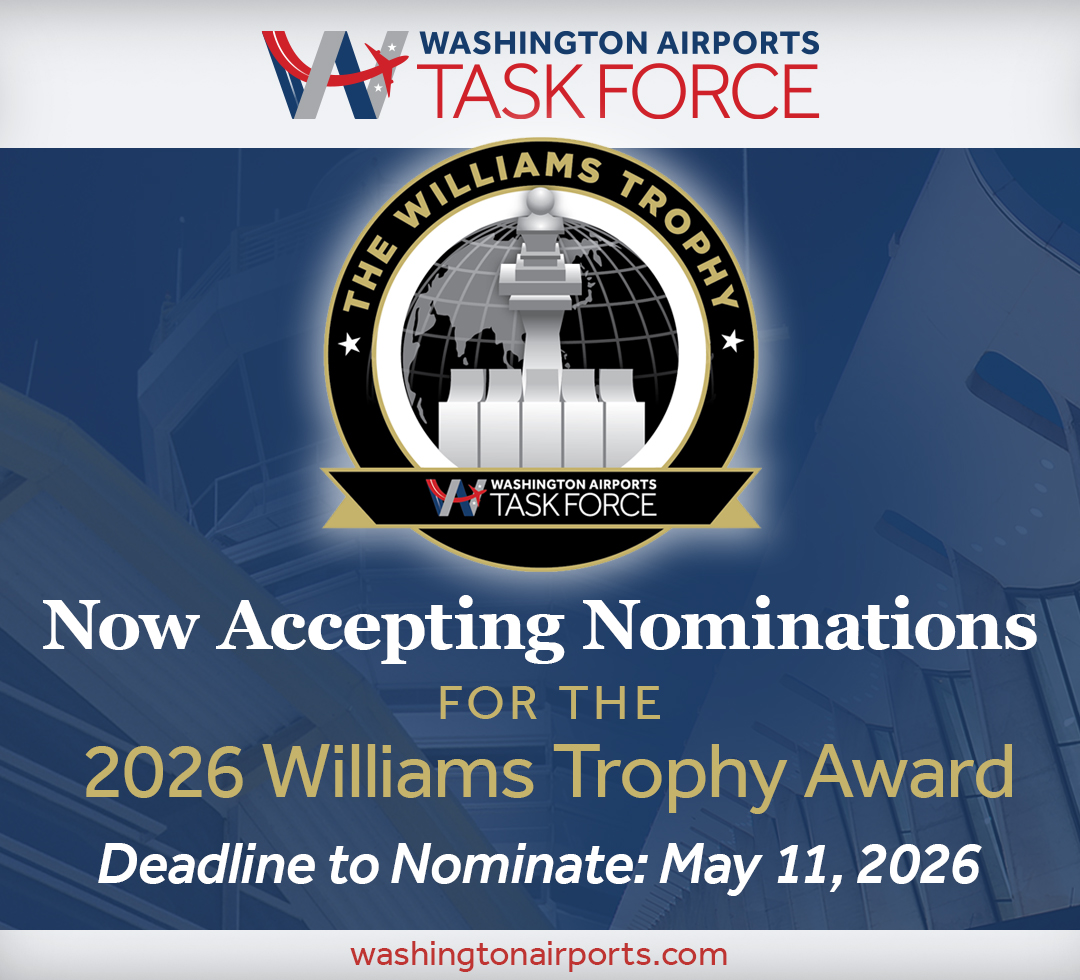
The Washington Airports Task Force is gaining altitude as we rally our network, community, and aviation enthusiasts to submit nominations for the 2026 Williams Trophy Awards. This is your chance to help recognize the leaders and innovators shaping the future of aviation and space. Now in its 30th year, the Williams Trophy continues to stand as one of the industry’s most prestigious and inspiring honors.

Established in 1996 by the WATF Board of Directors, the award celebrates the legacy of Carrington Williams, the organization’s founding chairman (1982–1996) and its first recipient. The Williams Trophy recognizes those whose “Leadership, Vision and Dedication in the Application of Aviation or Space Enrich the Quality of Life on Earth,” while advancing a forward-looking vision and an unwavering commitment to aviation and the human connections it brings together.

Your nomination does more than spotlight excellence—it helps shape the story of the year. From influencing the selection of this year’s recipient(s) to inspiring the theme of WATF’s Annual General Meeting (AGM), your voice plays a key role in one of our most anticipated events. The 2026 AGM, taking place later this year, is expected to once again bring together a full and energized audience to celebrate the very best of our industry.

Do you know an individual, organization, or breakthrough worthy of this recognition? Submit your nomination by answering three simple questions here. The deadline is May 11, 2026—don’t miss the opportunity to help spotlight excellence and fly the future forward.

View past recipients here.

Questions? Reach out anytime at [email protected].

2026 CFDCO Dulles Airport Scholarship Program

Buckle up your seatbelts…

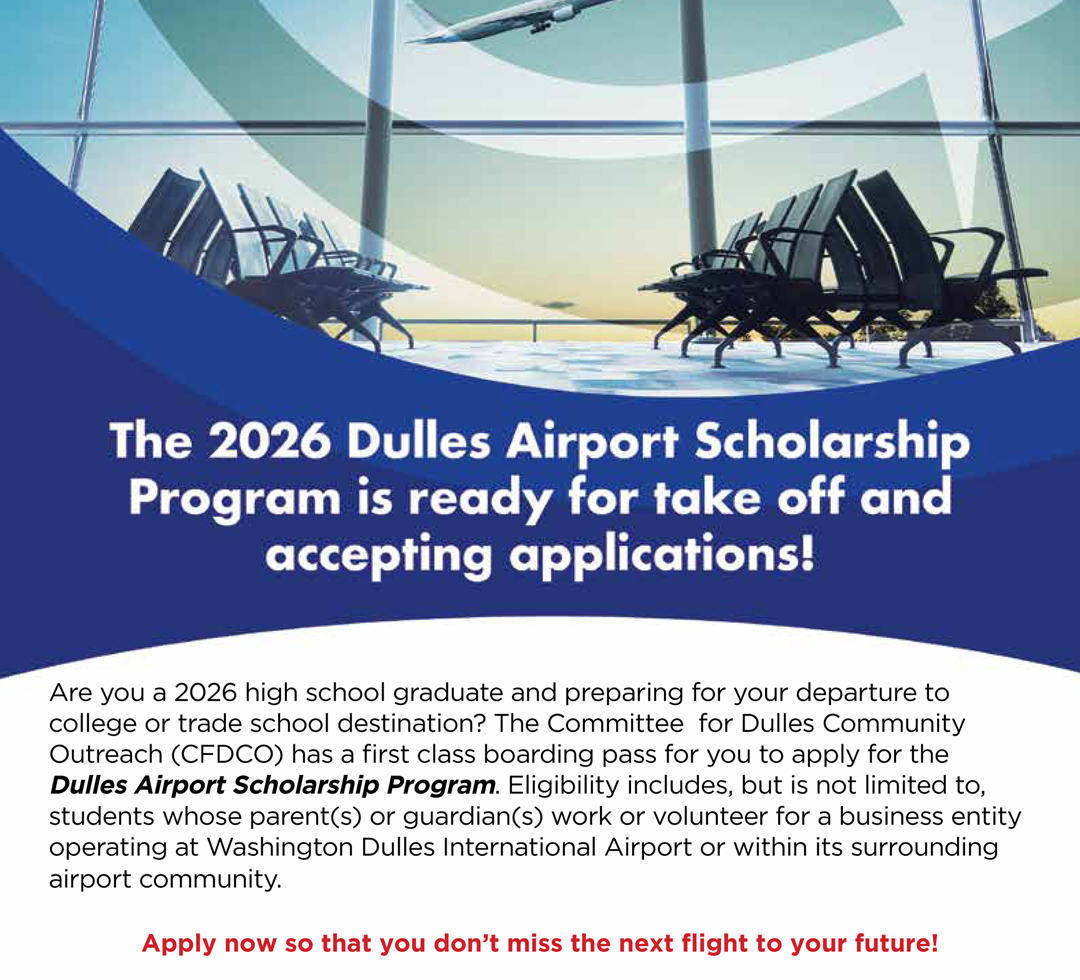
The Committee for Dulles Community Outreach (CFDCO) is now accepting applications for its 2026 Dulles Airport Scholarship Program, which provides financial assistance to 2026 high school graduating students enrolling in accredited college, university or trade school.

“The rising costs of college and trade school continue to be one of the biggest obstacles to launching a successful career. The CFDCO Dulles Scholarship plays a vital role in empowering a group of talented future professionals, while alleviating some of the financial strain,” said Lisa Merhaut, President of CFDCO.

Eligibility is as follows: 

1. Applicant must be an employee or volunteer of, or the dependent of an employee or volunteer of, a business or agency operating in the Washington Dulles Airport community. (This is defined as inside the fence that surrounds the entire airport property.)

2. Applicant is a graduating high school senior (Class of 2026).

3. Applicant must enroll in an accredited community college, trade school, college, or university.  The applicant may be full-time or part-time.

4. Applicant demonstrates leadership and commitment to the community through involvement in extracurricular, community and/or volunteer activities. 

6. No financial disclosure is required; scholarship is not based on need.

FOR MORE DETAILS ABOUT THE PROGRAM, click here.

TO APPLY ONLINE, click here. Applications must be submitted online by April 6, 2026, and include an essay, academic transcripts, and a letter of recommendation. By supporting tuition and other expenses, the scholarship continues to advance its core value of strengthening the ability to support students while expanding access to educational resources. Since 2012, 313 scholarships totaling $475,000 to graduating high school seniors who work/volunteer or have parents who work/volunteer within Dulles Airport’s perimeter. In addition, $59,000 in grants to local organizations that support the airport and Dulles Aiport passengers, including travelers aid operations and the interfaith chapel.

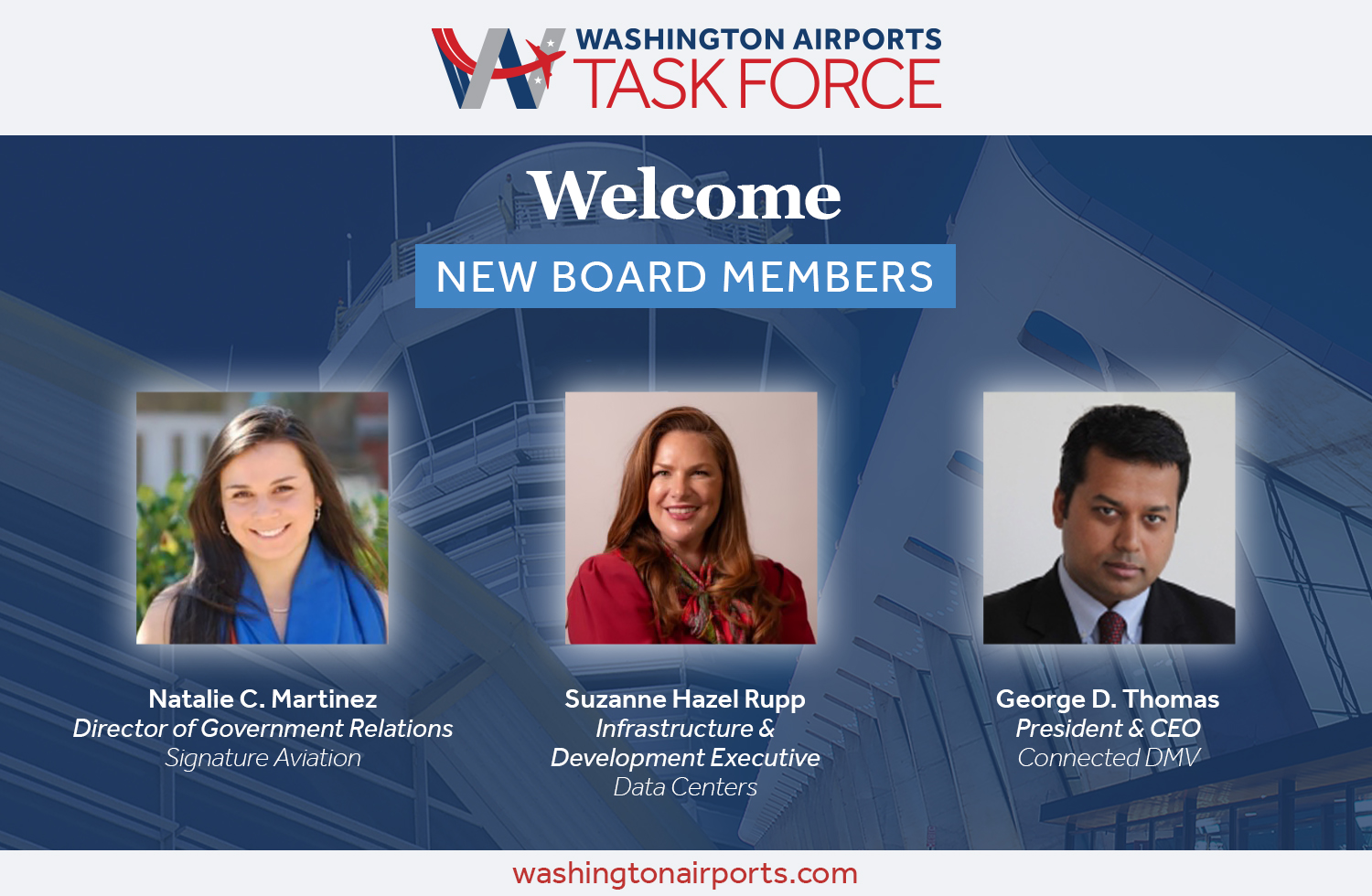
New Board Members: The Washington Airports Task Force Welcomes Natalie C. Martinez, Suzanne Hazel Rupp, and George D. Thomas

We are pleased to welcome Natalie C. Martinez, Suzanne Hazel Rupp and George D. Thomas to the Board of Directors of the Washington Airports Task Force (WATF). As we continue to advance our mission of fostering economic growth and innovation in the aviation sector, the addition of these distinguished leaders will provide invaluable insights and expertise to our organization.

We look forward to collaborating with them on key initiatives aimed at strengthening the aviation sector within the Commonwealth of Virginia and the broader National Capital Region. Together, we will continue to drive the development of sustainable growth, improved infrastructure, and stronger partnerships in the industry.

Thank you for your commitment to WATF’s mission, and we are excited to see the impact of your contributions in the years ahead.

In Remembrance of January 29, 2025, Tragedy at Washington Reagan National Airport

Today, on the one-year anniversary of the tragic crash at National Airport, we honor the 67 lives lost, including passengers, crew members, and others whose families and loved ones will forever carry this grief.

We also recognize the incredible support from local and regional first responders, officials, MWAA employees, and all those who stepped up during this crisis. Their swift, compassionate actions embodied the highest standards of public service and heroism. We extend our deepest gratitude to those on the front lines for their tireless efforts and unwavering commitment to the safety of our community.

We invite you to watch the Metropolitan Washington Airports Authority video dedicated to those lost and everyone impacted on this tragic day. May we keep those touched by this accident in our hearts and remember them always.

Click here to watch the tribute video.

#NeverForgotten #InOurHearts #HeroesAmongUs

New Board Member: The Washington Airports Task Force Welcomes Mr. Chris Morrison, FAIA, NCARB, LEED AP BD+C

Please join us in welcoming Chris Morrison to the WATF Board of Directors, where he brings an exceptional depth of expertise not only from his distinguished career in architecture and design leadership, but also through his steadfast advocacy for community engagement, mentorship, and LGBTQ+ rights.

After a decade as Managing Director of Perkins & Will’s Washington, DC studio, Chris has transitioned back to his role as Managing Principal to focus on architectural practice. With over 30 years of experience, his expertise spans architecture, historic preservation, adaptive reuse, resilience, and planning. His work has earned several prestigious honors, including the Catalyst Award, AIA Washington Chapter’s Award of Excellence, the D.C. Mayor’s Award for Excellence in Historic Preservation, and a GSA Merit Award for Design Excellence.

Beyond his professional achievements, Morrison contributes to the community by serving on the boards of the National Building Museum, Young Concert Artists, Community Forklift, and Watergate West Residences. He remains passionate about design excellence, Living Design principles, mentoring emerging architects, and advocating for LGBTQ+ rights.

Announcing the 2025 Williams Trophy Honorees and Annual General Membership Meeting

Announcing the 2025 Williams Trophy Honorees and 43rd Annual General Meeting

The Washington Airports Task Force is proud to unveil the honorees for this year’s prestigious Williams Trophy Award, to be presented at our 43rd Annual General Membership Meeting.

The prestigious Williams Trophy is awarded to recognize those whose “Leadership, Vision and Dedication in the Application of Aviation or Space Enriched the Quality of Life on Earth.”

This year’s theme — “Eye on the Future: The Skies of Tomorrow” — shines a spotlight on innovators reshaping aviation through technology, sustainability, and passenger experience:

🌟 Boom Supersonic
🌟 Electra
🌟 Joby Aviation

We are also honored to welcome Greg Campbell, Director of the Virginia Department of Aviation, as our keynote speaker.

The program will include a meet and greet where the honorees will have the opportunity to showcase their technology.

Learn more about the award and its history:
🔗 Washington Airports Task Force
🔗 Williams Trophy Award

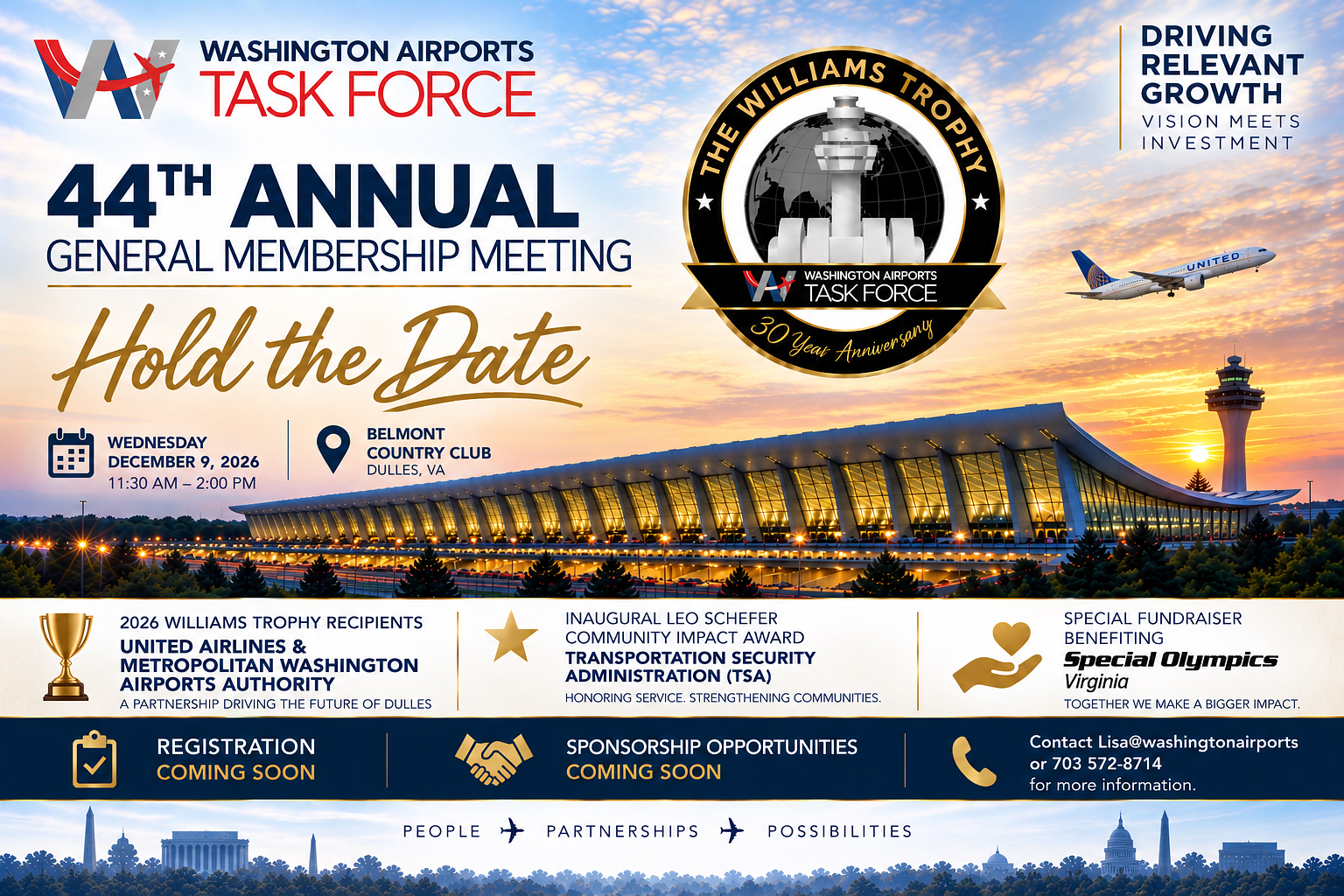
SAVE THE DATE: Join us as we recognize these trailblazers and look ahead to the future of flight, at the Annual General Meeting, on Tuesday, December 2, 2025, 11am-2pm at Belmont Country Club.

With such an outstanding lineup of companies on stage, this year’s event is shaping up to be truly unforgettable.

Much more to follow!

Contact Lisa Merhaut for more information regarding the event and Mark Treadaway for sponsorship opportunities.

Dulles Airport Scholarship Program Awards 50 Scholarships

The Committee for Dulles Community Outreach (CFDCO), the charitable arm of the Committee for Dulles (CFD), is pleased to announce it has awarded 50 Dulles Airport Scholarship Program recipients totaling $60,000 to local graduating high school seniors who are employed or volunteer at Washington Dulles International Airport (Dulles) or who are dependents of employees or volunteers at the airport.

Click here to view the entire press release.

Viewpoint: American Legion Bridge Should be Maryland’s Top Transportation Priority

Bravo to the Washington Post for publishing two Letters to the Editor about the region’s worst traffic bottleneck, the American Legion Memorial Bridge. Individual kudos to WATF Board Director, Bob Buchanan, and former Maryland Secretary of Transportation Robert Flanagan for speaking out and offering solutions to fix the problem and forge a path forward. The Washington Airports Task Force is keeping its Eye on the Future by strongly supporting the Northern Virginia Transportation Alliance and its goal of maintaining reliable funding sources and plans for the expansion of our transportation infrastructure.

Growing up in Montgomery County, I have seen firsthand how the opening of the Capital Beltway in the early 1960s transformed our community. It’s no coincidence that today the Beltway connects the D.C. region’s three most populous jurisdictions — Montgomery, Prince George’s and Fairfax counties. From Tysons and Springfield to Greenbelt and National Harbor, it’s clear that this critical transportation infrastructure facilitates tremendous economic growth for the D.C. region.

But while Virginia has continued to make significant investments in the Beltway, I-95 and I-66 over the last two decades, Maryland has done nothing. And this inaction is most felt by commuters when trying to cross the Potomac River. The American Legion Bridge is now more than 60 years old and was last improved in 1992. Since that time, Fairfax and Montgomery counties together have added half a million residents.

CLICK HERE to read full article.